Spotify vs Apple Music: Where to Focus Your Promotion
Spotify vs Apple Music: Where to Focus Your Promotion
If you're an artist trying to grow your audience or maximize your music revenue, choosing between Spotify and Apple Music is key. Here's the short version:
- Spotify is better for discovery. It has 751 million monthly users, including a large free tier, and its algorithm-driven playlists like Discover Weekly can help you reach new listeners fast.
- Apple Music pays more per stream ($0.007–$0.01 vs. Spotify’s $0.003–$0.005) and offers a premium audience that listens longer and values quality.
Quick Overview:
- Spotify: Best for building a fanbase, especially for younger, global audiences. Use tools like Marquee and Discovery Mode for visibility.
- Apple Music: Ideal for earning more per stream and connecting with older, high-income listeners. Focus on library adds and Shazam tags.
Pro Tip: Start with Spotify to grow your audience, then shift focus to Apple Music for higher revenue as you scale. Tools like PromoLinks.me can help manage campaigns across both platforms.
Spotify Promotion Opportunities
Spotify's User Base at a Glance
Spotify boasts an impressive 751 million monthly active users and 290 million premium subscribers as of early 2026. In the U.S., the platform's audience leans heavily toward younger demographics: 55% of users are between 18 and 34 years old, with 26% aged 18–24 and 29% aged 25–34. For artists aiming to connect with a tech-savvy, youthful crowd, Spotify is a natural playground.
The free, ad-supported tier might not pay much per stream, but it plays a crucial role in music discovery.
"Spotify's free tier is not a weakness. It creates a funnel. Free users who discover your music through algorithms often convert to saves, follows, and then premium listens."
Interestingly, about 72% of Spotify sessions happen on mobile devices, with peak listening times around 8 a.m. and 6 p.m. on weekdays. These stats can help you plan your promotional efforts for maximum impact. Combined with Spotify's built-in tools, this engaged audience becomes an excellent target for artists looking to grow their fanbase.
Key Tools Inside Spotify for Artists
Spotify provides a range of tools, both free and paid, to help artists promote their music effectively.
The Playlist Pitching tool, part of Spotify's free Campaign Kit, lets you submit unreleased tracks to Spotify's editorial team. Playlists like RapCaviar and Today's Top Hits are within reach, even for smaller artists. In 2024, 74% of editorial playlist additions were for artists with fewer than 100,000 monthly listeners. For instance, Latin artist Jay Wheeler used this tool to land a spot on the "Trap Land" playlist, earning 100,000 streams.
On the paid side, Marquee and Showcase offer premium promotional options. Marquee displays a full-screen recommendation when users open the app, perfect for promoting new releases during their first 21 days. Showcase places a banner at the top of the Home feed for both new and older tracks. Both tools require a $100 minimum budget, with cost-per-click rates between $0.30 and $0.50. Marquee campaigns have shown to deliver 10x more listeners per dollar compared to social media ads.
For a different approach, Discovery Mode offers an algorithmic boost at no upfront cost. Instead, Spotify takes a 30% commission on royalties earned from Radio and Autoplay streams. Independent R&B artist thuy used Discovery Mode alongside Marquee in 2023, growing her monthly listeners by over 300%, reaching fans in 178 countries, and racking up 230,000 saves and 210,000 playlist adds.
Additional features like Canvas (looping visuals), Artist Pick (highlighted content), and Countdown Pages (pre-save hubs) give artists even more ways to connect with listeners. Countdown Pages, for example, can double pre-save numbers when launched at least 7 days before release. Nearly 60% of fans who pre-save an album stream it within the first week.
How Spotify's Discovery Algorithm Works
Spotify’s recommendation system uses three primary signals: collaborative filtering (grouping listeners with similar tastes), natural language processing (analyzing web content and metadata), and audio analysis (evaluating elements like tempo and key). These signals power playlists like Discover Weekly and Release Radar, which are essential for reaching new and existing fans.
To improve your chances of algorithmic success, focus on your track's save rate. Songs with a save rate above 4% are five times more likely to land in algorithmic playlists. Completion rate also matters - getting listeners to stay past the 30-second mark can significantly impact your track's performance. For example, a song with 10,000 streams and a 30% save rate can outperform one with 50,000 streams but only a 5% save rate over time.
Pitching your music 4–6 weeks before release gives Spotify's editorial team enough time to evaluate it. Even if your track doesn’t make it onto an editorial playlist, the genre and mood tags you submit during the pitch process can help the algorithm recommend your music to the right audience in the future.
Spotify Royalties and Long-Term Growth
Spotify pays artists an average of $0.003 to $0.005 per stream, with premium streams typically on the higher end of that range. To generate royalties, a track needs at least 1,000 streams in a rolling 12-month period as of 2024.
The key to long-term growth on Spotify lies in building algorithmic momentum. Strong save and completion rates signal quality to Spotify’s system, which helps grow your audience with each new release. Using a waterfall release strategy - releasing singles every 4–6 weeks - keeps your music cycling through Release Radar and increases your chances of editorial playlist consideration.
Additionally, over two-thirds of highly engaged "super listeners" continue streaming an artist's music six months after discovering them. This means that early traction can snowball into sustained growth.
sbb-itb-e819543
Apple Music Promotion Opportunities
Apple Music's User Base at a Glance
Apple Music boasts a global subscriber base of approximately 100 million as of 2026, with U.S. users recently surpassing Spotify's numbers. Unlike Spotify, Apple Music operates solely on a paid subscription model. This approach attracts a demographic that tends to be slightly older, has more disposable income, and is deeply integrated into the Apple ecosystem. These users often rely on devices like the iPhone, Mac, HomePod, and CarPlay, emphasizing their preference for premium audio experiences. This creates an audience that’s more likely to form meaningful connections with artists.
These unique traits are further supported by a suite of tools designed specifically for artists, as outlined below.
Key Tools Inside Apple Music for Artists
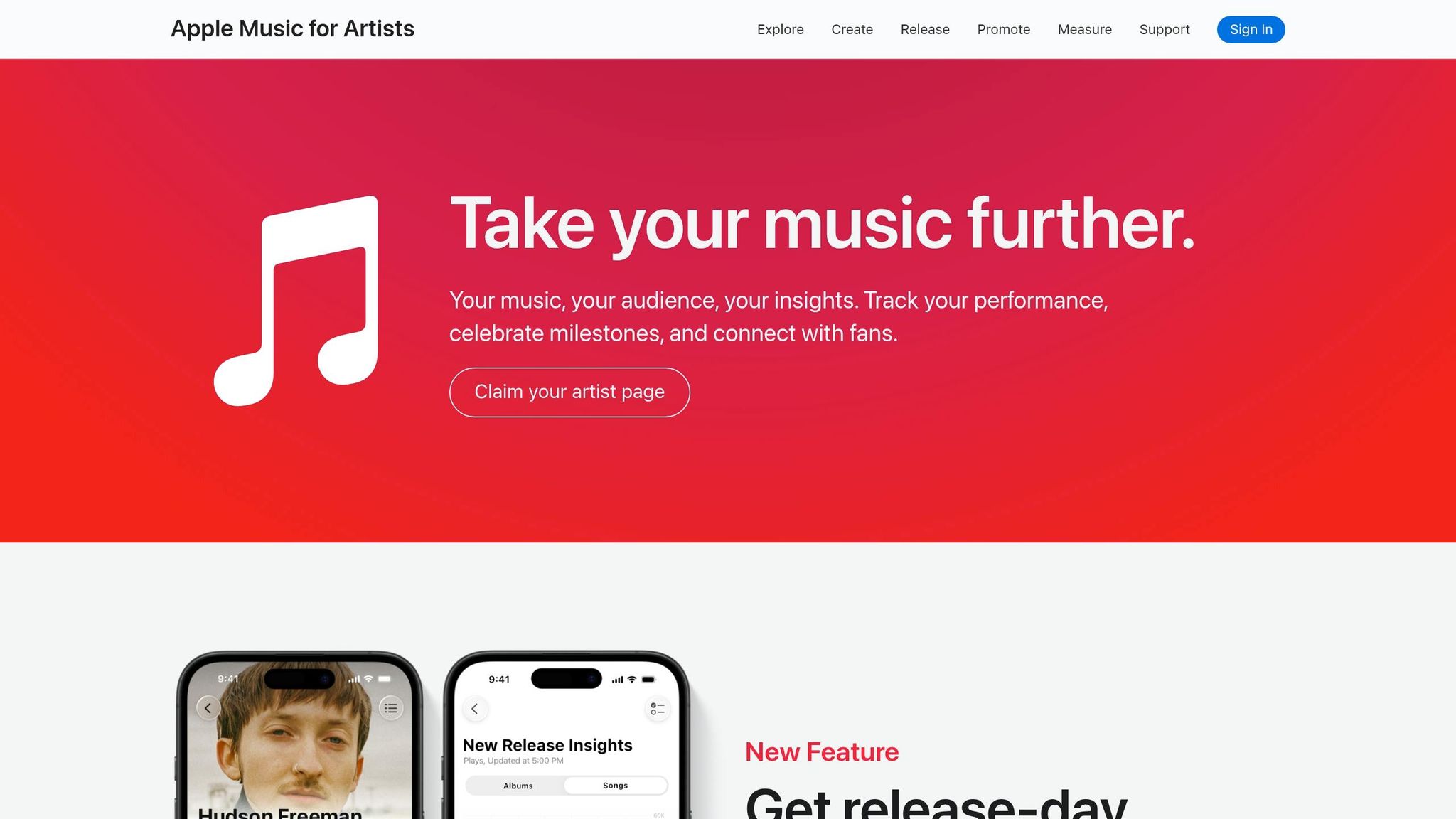
Apple Music for Artists (AMfA) is a free platform available to all verified artists. It offers in-depth analytics, including stream counts, listener demographics, and location data down to the city level across over 100 countries. Additionally, it provides Shazam insights and tracks library adds - an important metric for gauging long-term listener interest.
"On Apple, library adds are the gold metric. They mean someone wants you in their permanent rotation." - One-Submit
AMfA also includes several marketing features, such as:
- Customizable QR codes for easy sharing
- Embeddable players with 30-second previews for non-subscribers
- Shareable Milestones for social media promotion
- Synced lyrics submission for engaging listeners
- Set Lists, which turn live concert setlists into playlists for fans
These tools equip artists with the resources needed to build stronger connections with their audience.
Editorial Curation and Discovery on Apple Music
Apple Music stands out by focusing on human curation rather than relying solely on algorithms for music discovery. While its analytical tools are robust, the platform’s editorial team plays a key role in spotlighting tracks. Radio shows like Apple Music 1 are instrumental in this process.
"Apple Music's editorial team is recognized for its more selective and high-quality focus... often spotlighting tracks with strong media, label, or cultural traction." - iMusician
To increase the chances of being featured, artists should pitch unreleased tracks at least 3–4 weeks before their release date through iTunes Connect. Apple’s editorial team considers the full story behind a release, including the artist’s identity, press coverage, and broader cultural relevance, rather than just focusing on streaming numbers. Additionally, tracks mastered in Spatial Audio (Dolby Atmos) gain extra algorithmic visibility on compatible devices, which account for an estimated 65%–75% of Apple Music plays.
Apple Music Revenue and Ecosystem Advantages
Apple Music offers higher payouts compared to Spotify, with an average payment of $0.007 to $0.010 per stream. This translates to 2–3 times more revenue per stream, and tracks mastered in Dolby Atmos earn an additional 10% royalty bonus.
| Monthly Streams | Estimated Apple Music Revenue | Payout Advantage vs. Spotify |
|---|---|---|
| 10,000 | $80–$100 | ~2–3x higher |
| 100,000 | $800–$1,000 | ~$500–$700 more |
| 500,000 | $4,000–$5,000 | ~$2,500 more |
Beyond revenue, the Apple ecosystem offers unique discovery opportunities. Features like Siri recommendations, CarPlay integration, and the standalone Apple Music Classical app provide additional ways for listeners to engage with music. These advantages make Apple Music a compelling platform for artists looking to maximize both revenue and audience reach.
SPOTIFY VS APPLE MUSIC: WHICH IS BETTER FOR INDEPENDENT ARTISTS | MUSIC INDUSTRY TIPS
Spotify vs. Apple Music: Side-by-Side Comparison
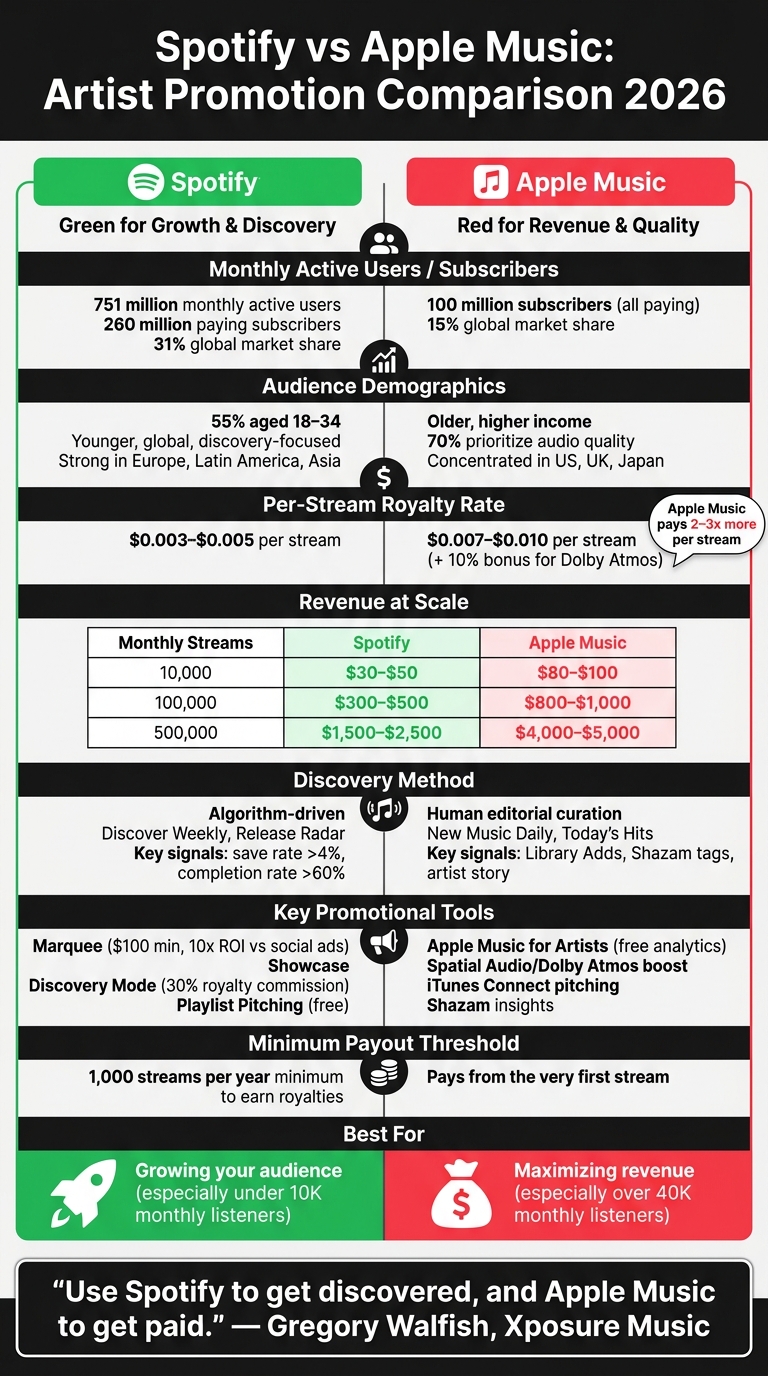
Spotify vs Apple Music: Artist Promotion Comparison 2026
Audience Size and Demographics
Spotify's reach is undeniable, boasting 751 million monthly active users and 260 million paying subscribers, which accounts for around 31% of the global streaming market. Meanwhile, Apple Music has approximately 100 million subscribers, all of whom are paying, giving it about 15% market share. This difference highlights Spotify's broader appeal, especially among younger, global users, while Apple Music tends to attract an older, more premium audience.
Spotify's user base is younger and spans across regions like Europe, Latin America, and parts of Asia. On the other hand, Apple Music's audience is concentrated in high-income markets such as the U.S., UK, and Japan, and its users are 70% more likely to prioritize audio quality when choosing a subscription.
"Spotify users are more social and discovery-focused - its UI encourages playlist sharing, story integration, and viral growth. Apple Music users, however, tend to stream fewer songs but listen longer and with more focus." - Alexandra, Poise Artists
In essence, Spotify is ideal for building a broad audience, while Apple Music provides an environment better suited for monetizing that audience.
Discovery Systems and Playlist Ecosystems
The two platforms differ significantly in how they help listeners discover music.
Spotify leans on algorithms. Its recommendation system evaluates metrics like completion rates, save rates, and repeat listens to promote tracks on playlists like Discover Weekly and Release Radar. Songs with strong early engagement can quickly reach a large audience without needing editorial input. The algorithm's primary focus is on save rate and completion rate - if more than 60% of listeners finish your track and save it, you're likely to see a boost.
Apple Music relies on human curation. Editorial teams select tracks for major playlists like New Music Daily and Today's Hits, factoring in artist identity, press coverage, and broader cultural relevance instead of just numbers.
"Spotify wants engagement metrics. Apple wants taste, story, and a strong artist identity. You're not gaming a system. You're convincing a human." - One Submit
For independent artists, Spotify's algorithm-driven approach is more accessible, while Apple Music's editorial model can be tougher to navigate. However, Library Adds and Shazam tags are critical signals that can help artists break through on Apple Music.
Understanding these systems is key to developing a strategy, especially when paired with the platforms' differing payout structures.
Royalty Rates and Payout Structures
Apple Music offers higher payouts per stream, which can add up significantly over time.
| Monthly Streams | Spotify Revenue | Apple Music Revenue |
|---|---|---|
| 10,000 | $30–$50 | $80–$100 |
| 50,000 | $150–$250 | $400–$500 |
| 100,000 | $300–$500 | $800–$1,000 |
| 500,000 | $1,500–$2,500 | $4,000–$5,000 |
Estimated 2026 USD
Spotify's freemium model lowers its average per-stream payout to $0.003–$0.005, while Apple Music's subscription-only model maintains a higher rate of $0.008–$0.010. Additionally, Spotify has a 1,000-stream annual minimum, meaning tracks with fewer streams earn nothing. Apple Music pays artists from the very first stream.
"The math rarely favors Apple Music for early-stage artists focused on growth over income." - Chartlex
These differences highlight the trade-off between Spotify's growth potential and Apple Music's higher earnings per stream.
Analytics and Artist Tools
Spotify for Artists provides real-time data on streams, playlist placements, listener demographics, and follower growth. Apple Music for Artists emphasizes intent-based metrics like Shazam data and Library Adds, which are particularly useful for spotting early trends - a spike in Shazam tags often signals upcoming streaming growth.
Spotify also offers paid promotional tools like Marquee, Showcase, and Discovery Mode, which can boost visibility but sometimes come with reduced royalty rates. Apple Music's dashboard, meanwhile, includes city-level insights that help artists identify where their fanbase is growing before it peaks.
One limitation of both platforms is the lack of cross-platform analytics. This is where tools like PromoLinks.me step in, offering unified data on clicks and conversions across platforms. With PromoLinks.me, artists can track not just how many people clicked their links, but also which platform was chosen and the source of the traffic. This kind of insight is something neither Spotify for Artists nor Apple Music for Artists currently provides.
How to Choose Your Platform Focus
Matching Goals to Platform Priorities
Your career stage plays a big role in deciding where to focus your energy. If you're an emerging artist with fewer than 10,000 monthly listeners, Spotify's algorithmic playlists - like Discover Weekly and Release Radar - can be a game-changer. These playlists are responsible for about 35% of new artist discoveries. On the other hand, if you're more established, Apple Music's higher per-stream payouts might make it a better fit. With Apple Music paying around $0.008 per stream compared to Spotify's $0.004, the revenue difference can add up significantly as your audience grows. Plus, Apple Music's editorial focus often favors artists with an existing track record, making it a stronger option once you've gained traction.
The type of music you create also matters. Spotify's playlist-driven approach works well for pop, hip-hop, and EDM, while Apple Music tends to attract more engaged listeners for classical, jazz, and singer-songwriter genres. Their Apple Music Classical app is especially appealing for classical music fans.
Once you've chosen a platform that matches your audience and revenue goals, the next step is to tailor your strategy to your budget.
Working Within Your Budget and Schedule
Your promotional budget dictates how you divide your efforts between platforms. Here’s a simple breakdown based on monthly spending:
| Monthly Budget | Spotify Allocation | Apple Music Allocation | Objective |
|---|---|---|---|
| $100–$500 | 70% | 0% | Focus on algorithmic growth |
| $500–$2,000 | 50% | 10% | Balance exposure and revenue |
| $2,000+ | 40% | 20% | Expand across both platforms |
Spotify offers tools like Marquee, Showcase, and Discovery Mode, which give you direct control over your music's visibility. Apple Music doesn't have similar self-serve promotion options, so any budget allocated there might be better spent on external ads that funnel listeners to your music through a smart link.
Timing is also key. Submit your track to Spotify at least 28 days before release, and pitch it to Apple Music 3–4 weeks in advance. Missing these deadlines can limit your reach, leaving you to rely solely on organic growth after your release.
Using PromoLinks.me for Cross-Platform Campaigns
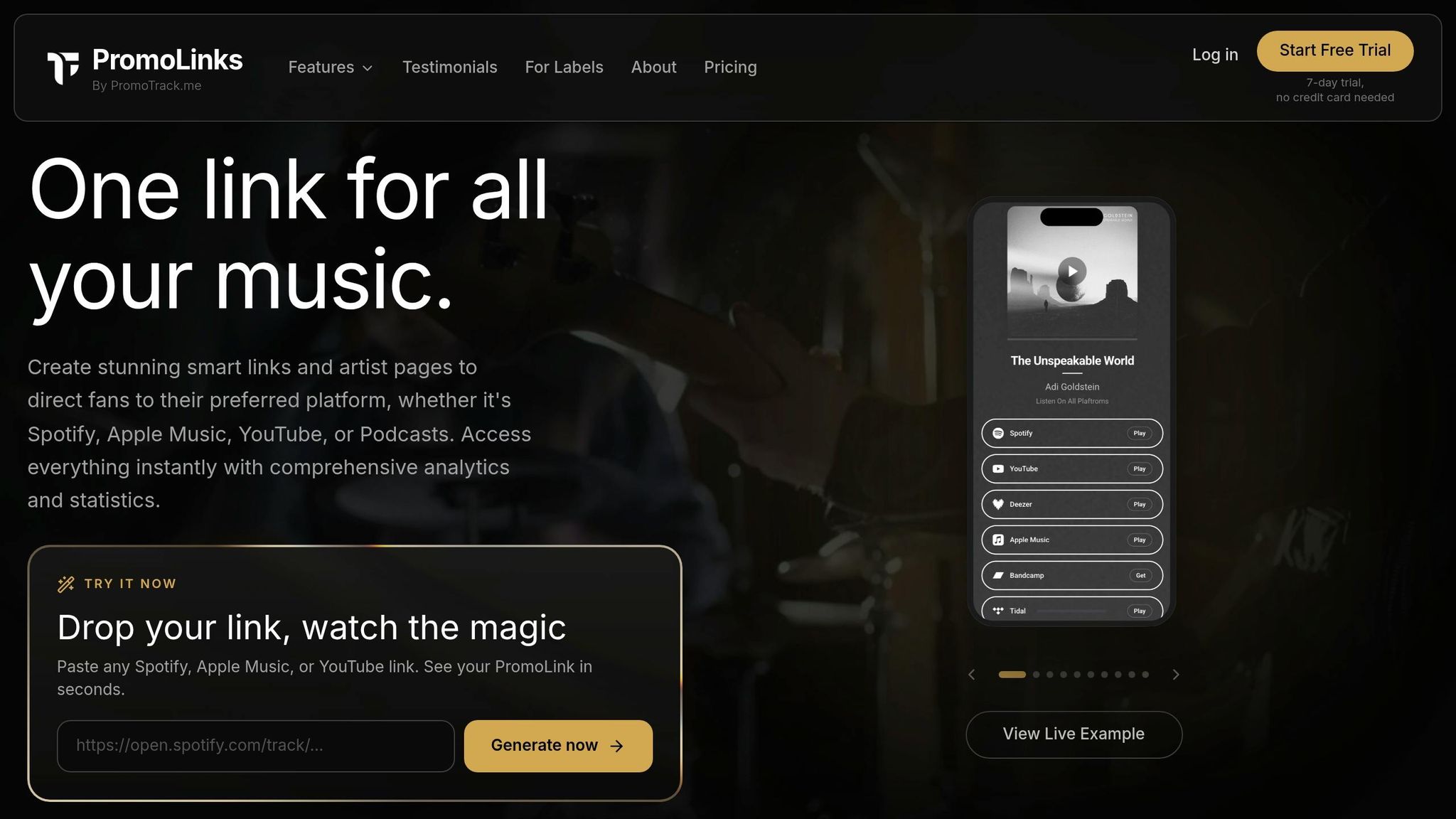
PromoLinks.me simplifies cross-platform campaigns by using a single smart link that tracks your audience's preferences. This tool detects a fan's device and installed apps, providing analytics like total clicks, platform preferences, and traffic sources. These insights help fine-tune your budgeting for future campaigns. You can even create QR codes from your smart link to include on merchandise or flyers, making it easy for fans to access your music with just a couple of taps.
"Use Spotify to get discovered, and Apple Music to get paid." - Gregory Walfish, Founder and Co-CEO, Xposure Music
PromoLinks.me offers an Indie plan starting at $7/month (billed annually), which includes smart links, pre-save campaigns, QR codes, and basic analytics. It’s an affordable way for independent artists to coordinate their cross-platform strategies and maximize their reach without breaking the bank.
Conclusion
Spotify and Apple Music serve distinct purposes in an artist's journey: Spotify excels at discovery, while Apple Music offers higher payouts. The difference in per-stream rates - $0.003–$0.005 for Spotify versus $0.007–$0.010 for Apple Music - makes each platform better suited to specific career stages.
Aligning your platform strategy with your goals is the key to success.
Key Takeaways
A balanced approach is the smartest way forward. Spotify helps you grow your audience. Apple Music helps you earn. This simple distinction highlights how each platform's unique features and user base can complement one another.
"The artists who grow fastest treat this as a 'both/and' question, not an 'either/or.'" - Chartlex
- Match your strategy to your career stage. Early on, focus on Spotify to build an audience. As your following grows, shift attention to Apple Music to benefit from its higher revenue potential.
- Take advantage of Dolby Atmos. Apple Music offers a bonus for Spatial Audio streams, which can boost your earnings.
- Monitor your metrics. Use Spotify for Artists and Apple Music for Artists to track key data like save rates, Shazam activity, and stream sources.
To streamline your efforts, consider tools like PromoLinks.me, which consolidates analytics and directs fans to their preferred platform. This not only helps you understand where your audience is but also improves the effectiveness of your campaigns by capturing detailed traffic data.
Data backs up these strategies. Chartlex's review of over 2,400 campaigns found that artists with 40,000+ monthly Spotify listeners saw a 30–50% increase in Apple Music streams within 60 days. This reinforces the power of a dual-platform approach: Spotify builds visibility, and Apple Music amplifies revenue, creating a compounding effect that any independent artist can leverage with a thoughtful promotional plan.
FAQs
When should I shift from Spotify growth to Apple Music revenue?
As your career evolves and your fanbase becomes more dedicated, it might be time to shift your focus from Spotify's growth-oriented platform to Apple Music's revenue potential. Here's why this transition makes sense:
Spotify is fantastic for discovery, thanks to its powerful algorithms and massive user base. It's the go-to platform for reaching new listeners and building initial momentum. However, when it comes to per-stream payouts, Apple Music outshines Spotify. While Spotify pays roughly $0.003 to $0.005 per stream, Apple Music offers a higher rate - around $0.01 per stream. This difference can add up significantly as your audience grows.
Making the switch to prioritize Apple Music becomes especially beneficial when your fans start engaging deeply with your albums, appreciate premium audio features, or when you're receiving editorial support from the platform. These factors can maximize your revenue while strengthening your connection with a loyal fanbase.
Which metrics should I track to improve Spotify algorithm picks?
To improve your odds of landing on Spotify's algorithmic playlists like Discover Weekly and Release Radar, it's crucial to prioritize engagement metrics rather than just focusing on play counts. Here are two key metrics to monitor in your Spotify for Artists dashboard:
- Save rate: A higher percentage of listeners saving your track shows strong interest and signals to Spotify that your music resonates.
- Skip rate: Tracks with lower skip rates demonstrate better listener retention, which is a positive signal for the algorithm.
These metrics play a big role in catching Spotify's algorithmic attention and boosting your playlist visibility.
How can I drive more Apple Music library adds and Shazam tags?
If you're looking to grow your Apple Music presence, focus on creating organic momentum. Library adds show that listeners want your music to be part of their daily playlists, while Shazam tags reflect real-world discovery - whether it's from concerts, radio, or other public plays.
To make the most of these metrics, consider these strategies:
- Run pre-add campaigns: Launch these efforts before your release date to build anticipation and encourage fans to save your music early.
- Pitch to Apple Music editorial: Work with your distributor to submit your music to Apple Music's editorial team. Aim to do this 7–10 days before your release for the best chance of being featured.
By combining these tactics, you can amplify both your library adds and Shazam tags, helping your music gain traction where it matters most.
Related Blog Posts
Ready to create your smart links?
Join thousands of artists using PromoLinks to promote their music smarter.
Get Started Free