Smart Links vs. Direct Links: What Drives More Fans
Smart Links vs. Direct Links: What Drives More Fans
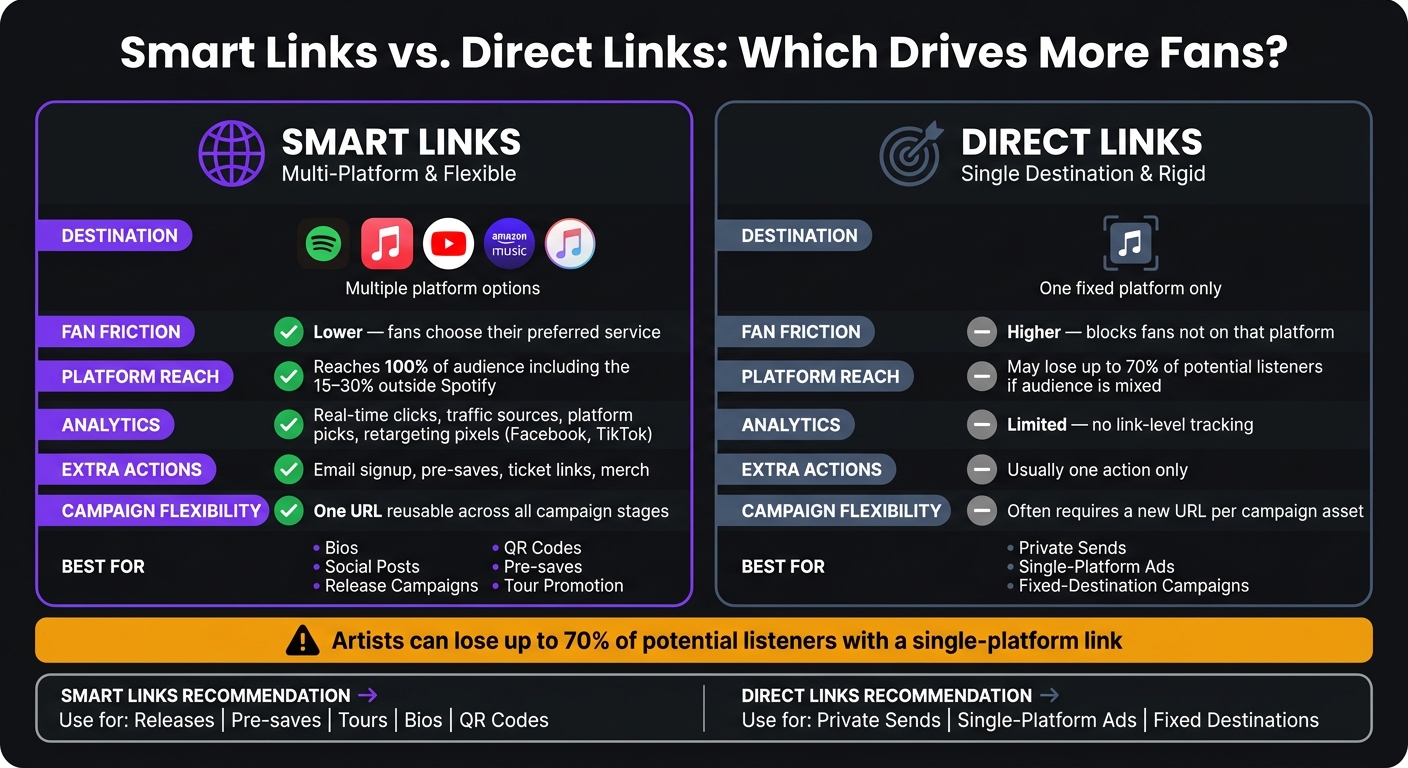
If I want the most people to reach my music, I’d pick a smart link in most cases. A single platform link can block a big part of my audience, and some reports say artists can lose up to 70% of potential listeners when they share only one service. Smart links fix that by giving fans one page with choices like Spotify, Apple Music, YouTube Music, tickets, and email signup.
Here’s the short version:
- Smart links are better for multi-platform reach
- Direct links are better for one fixed destination
- Smart links give me click data, platform data, and traffic source data
- Direct links are best for single-platform ads, SMS, or private sends
- Smart links can support pre-saves, QR codes, ticket links, and email signup
- A fan may decide to stay or leave in 2–3 seconds, so clear choices matter
- Around 15%–30% of listeners may use services outside Spotify
If I strip it down even more, the choice is simple:
- Use smart links for bios, social posts, release campaigns, and QR codes
- Use direct links when I know the fan should land on one app only
Smart Links vs. Direct Links: Which Drives More Fans?
What are SMART LINKS and How Can Musicians Use Them?
sbb-itb-e819543
Quick Comparison
| Criteria | Smart Links | Direct Links |
|---|---|---|
| Destination | Multiple platform options | One platform only |
| Best use | Releases, pre-saves, tours, bio links (see our pre-save campaign guide) | Single-platform ads, private sends |
| Fan path | More choice, less drop-off | Fast, but only for one service |
| Tracking | Clicks, sources, platform picks | Limited on its own |
| Extra actions | Tickets, email signup, pre-save | Usually one action |
| Reuse | Same URL can change by campaign stage | Often needs a new URL |
For me, the main takeaway is clear: smart links usually drive more fans because they remove dead ends and give people options. Direct links still have a place, but mostly when the destination is already decided.
How Smart Links Work for Multi-Platform Fan Access
Here’s what this looks like in practice: a smart link takes one URL and turns it into a branded landing page with clear platform options. That’s what stops fans from landing on a dead end. Instead of guessing where to go next, they see your cover art and artist name right away, followed by tap-to-open buttons for Spotify, Apple Music, YouTube Music, Amazon Music, and other major services. Many of these pages also include a short audio preview, so fans can hear the track before picking where to listen.
PromoLinks.me lets artists and labels build these pages with customizable templates, QR codes, real-time analytics, and fan email capture for music promotion across major listening platforms. The page can match the release artwork and branding, so the jump from social post to landing page feels smooth and familiar.
Common Uses: Releases, Pre-Saves, and Tour Promotion
The same link can play different roles during a campaign. A pre-save link can go live 3–4 weeks before release, collect emails, and save the track to a fan’s library on release day. Then, once the music is out, that same URL switches to a “listen now” page. No need to swap links or fix old posts.
Smart links can also do more than support release day. They can help with tour promotion through location-based ticket links, work as artist pages and link-in-bio tools that act as a standing artist hub, and serve as label pages that group multiple artists or releases in one place. QR codes from the same tool can be added to posters, merch, or stickers, turning in-person attention into streams and ticket sales.
What Fans See After the Click
A fan often decides whether to stay or leave within 2–3 seconds of landing on the page. That’s why a good smart link page cuts out confusion. Instead of assuming every fan uses the same app, it shows clear platform choices up front.
About 15%–30% of an artist’s audience uses platforms outside Spotify, including Apple Music and regional services. So giving fans options helps you reach listeners who might otherwise bounce. A mobile-first layout and fast load time help keep that spark of interest alive long enough for the fan to tap through and listen.
Smart Links vs. Direct Links: Side-by-Side Comparison
Now that the mechanics are clear, the next question is simple: which link type gets more fans through the door? The gap isn't just about features. It's about how many people actually make it to a stream, ticket page, or signup form.
| Criteria | Smart Links | Direct Links |
|---|---|---|
| Platform choice | Fans choose their preferred service | One fixed destination |
| Fan friction | Lower for mixed-platform audiences | Higher if the fan does not use that platform |
| Analytics | Aggregated click and destination data | No link-level tracking |
| Extra actions | Email signup, follows, ticket clicks, pre-saves | Usually supports one action only |
| Campaign flexibility | Easy to reuse across release stages | Often needs a new URL for each campaign asset |
The biggest gaps show up in three places: where fans land, what you can measure, and how much one click can do.
Fan Experience and Platform Access
A direct link sends everyone to the same destination. That can work if almost your whole audience uses one service. But that's a big if.
Smart links give fans a choice, so they can open the music on the platform they already use. That matters more than it might seem at first glance. A large share of fans may be on Apple Music or another non-Spotify service, so a Spotify-only link can shut out a big slice of possible first-day streams. Smart links can run in auto-redirect mode, sending fans based on their device or operating system, or they can let fans choose for themselves.
The point is pretty plain: fewer dead ends usually means more people get to the music.
Analytics, Tracking, and What Artists Can Learn
Direct links don't tell you much on their own. You can't see how many people clicked, where they came from, or which platform they picked.
Smart links add a layer before the fan reaches the streaming service. That gives you a much better read on fan behavior. You can see which traffic sources are doing the work, which platforms fans like most, and which markets are reacting.
PromoLinks.me supports real-time analytics and tracking pixels, including Facebook and TikTok pixels, so artists and managers can build retargeting audiences from fans who've already shown interest. And when that same link can also drive signups or ticket clicks, the data gets even more useful.
Going Beyond One Play: Multiple Actions from One Link
A direct link does one job: it sends someone to one place.
A smart link can do more with that same click. A fan might play the track, join an email list, or click over to merch or tickets from the same page. That's a big deal when you're trying to get more than a single stream out of a campaign.
"Pre-saves capture intent. Smart links distribute access." - Sonikit
Email capture matters here too. It gives you an audience you can reach on your own terms instead of hoping a social platform shows your post to the right people. That makes the next step easier: pick the link type that fits the goal of your music promotion across platforms.
When to Use Each Link Type
Pick the link type based on reach and goal: who you want to reach, where they listen, and what you want them to do next.
When Smart Links Are the Better Choice
Smart links make sense when you want more fans to get to your music, ticket page, or signup form with as little friction as possible. They work well in bios, social posts, video descriptions, and QR codes.
They also help when data matters. If you're running a paid social campaign and want to know which platform converts best, a smart link with tracking pixels gives you that view. You can also use pre-save smart links before a release, then switch the same page to a live listening page on release day.
Use smart links when reach and flexibility matter most. This approach is a key part of a music marketing checklist to ensure every platform is covered. Use direct links when the destination is already set.
When Direct Links Still Work
Direct links still do the job when the path is obvious and fans already expect that destination. Use them when the destination is fixed and the audience is already on that platform, like in private sends or single-platform ads.
How to Match Your Link Choice to Your Campaign Goal
Use the table below to match the link to the goal.
| Campaign Goal | Recommended Link Type | Reason |
|---|---|---|
| Multi-platform release | Smart link | Reaches fans across platforms |
| Pre-save campaign | Smart link (pre-save mode) | Captures intent before release day |
| Ticket sales / tour | Smart link with geo-routing | Sends fans to the correct ticket provider based on location |
| Email list growth | Smart link with email capture | Collects fan emails directly from the landing page |
| Private sends | Direct link | Simple and fast when the destination is already known |
| Single-platform ad | Direct link | Works when the ad and audience are tied to one service |
Conclusion: Which Link Type Drives More Fans
After looking at access, tracking, and conversion, the takeaway from our guides and comparisons is simple: smart links drive more fans when reach matters. Direct links still make sense when the destination is already set.
As streaming keeps spreading across more platforms, single-platform links can leave part of your audience just one tap away from your music.
The biggest edge with smart links is broader access plus a clear view into what’s working. Direct links don’t give you that same data layer.
Key Points to Recap
Smart links cut friction, support multiple destinations, and show what converts. Direct links still have a place when the destination is fixed and your audience is already on that platform.
Use smart links by default in bios, captions, and QR codes. If the destination is already decided and your audience is already there, a direct link is the faster move.
PromoLinks.me brings smart links, artist pages, pre-saves, QR codes, event pages, and fan email capture into one workflow for music promotion.
FAQs
Do smart links hurt conversions?
No. Smart links can lift conversions because they cut down the hassle that comes from platform fragmentation.
Instead of sending fans to just one service they may not even use, a smart link gives them a single place to pick their preferred platform. That can reduce drop-off, improve click-through rates, and lead to more total streams. PromoLinks.me helps you build smart links, artist pages, and pre-save campaigns to support that reach.
When should I use a direct link instead?
Use a direct link only when you’re sharing music with one known group on one specific platform.
For most professional music promotion, smart links make more sense. They cut friction, avoid turning away fans who use other streaming apps, and help you get more reach and better analytics.
What should a smart link page include?
A strong smart link page should feel like a branded mini-site that fits your music.
Start with the basics up front:
- Release artwork
- Track title
- Artist name
- A 30-second audio preview
That way, fans know right away they’re in the right place.
You’ll also want clear buttons for each streaming platform, plus pre-save options during pre-release periods. If it makes sense for your rollout, fan email capture can help build momentum and give you a direct line to listeners.
Related Blog Posts
Ready to create your smart links?
Join thousands of artists using PromoLinks to promote their music smarter.
Get Started Free