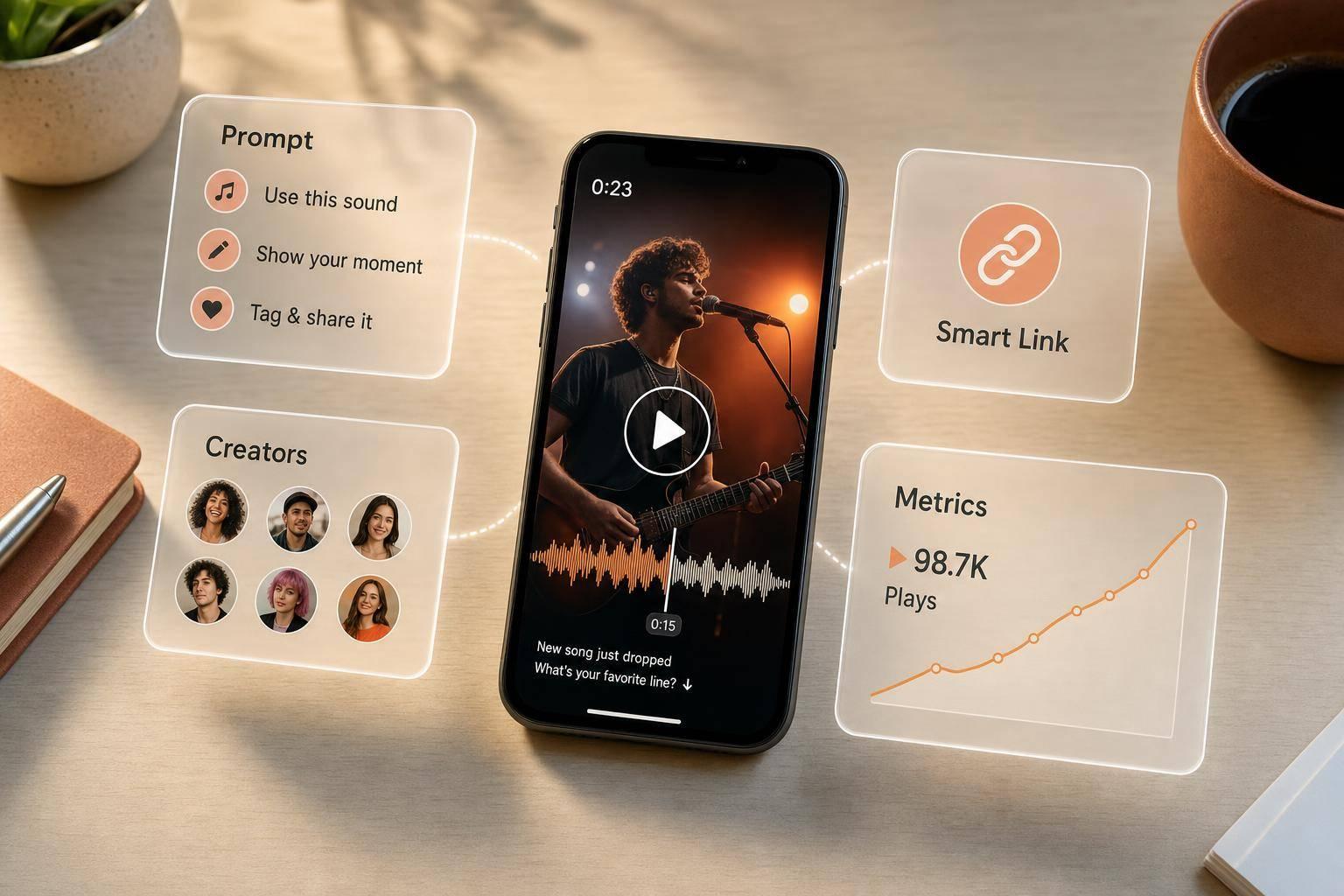
Ultimate Guide to UGC for Independent Artists
Ultimate Guide to UGC for Independent Artists
If you want more people to use your music, don’t start with polished promo. Start with a short clip, a clear prompt, and a simple path to your song.
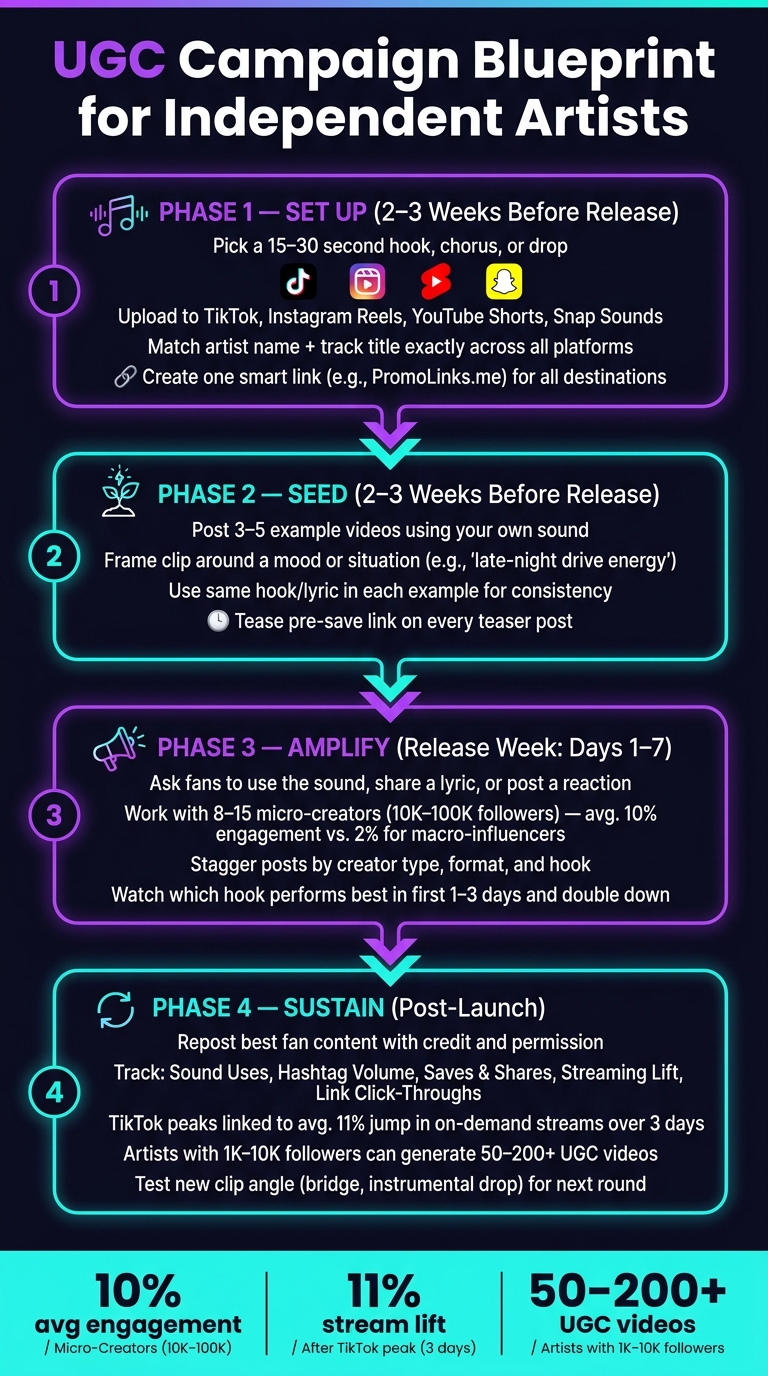
I’d sum it up like this: UGC helps independent artists get seen without a big budget because fans and small creators do the sharing for you. The article shows how to pick a 15–30 second song moment, get it live on TikTok, Reels, Shorts, and Snap, seed 3–5 example posts before release, work with micro-creators, and track signs like sound uses, shares, pre-saves, and stream bumps.
Here’s the full point in plain English:
- Pick one short clip people can reuse fast
- Upload your sound everywhere people post short videos
- Use one smart link so traffic doesn’t get messy
- Post examples first so fans know what to do
- Give easy prompts like reactions, lyric posts, or lip-syncs
- Push hardest around release week
- Work with fit-first creators, not just big follower counts
- Repost the best fan posts with credit
- Watch the numbers and use what worked on the next release
A few stats stand out:
- TikTok peaks have been tied to an average 11% jump in on-demand streams over the next 3 days
- Micro-creators in the 10,000–100,000 follower range often average about 10% engagement
- Bigger influencers often sit closer to 2%
- Artists with 1,000–10,000 followers may get 50–200+ UGC videos from a well-run push
If I were turning this article into one simple takeaway, it would be this: make participation easy. When fans know which clip to use, what kind of post to make, and where to find the full song, your release has a better shot at turning social posts into streams.
UGC Campaign Blueprint for Independent Artists
Set Up Your Music So Fans Can Use It Easily
Pick Short Song Moments That Are Easy to Reuse
Not every part of a song works well for UGC. The clips people reuse most tend to stand on their own. Think strong hooks, first choruses, beat drops, or a lyric that hits with feeling.
A good target is a 15- to 30-second clip that grabs attention fast, loops cleanly, and fits different types of creator content. And no, the chorus isn't always the best pick. Pre-choruses, intros, and instrumental drops can give creators more space to tell their own story.
Once you've picked the clip, make it dead simple for fans to find.
Make the Audio Available Where UGC Happens
Use a distributor to send your track, metadata, and royalties to TikTok, Instagram Reels, YouTube Shorts, and Snap Sounds.
After your track goes live, keep everything consistent. Your artist name, track title, and sound title should match exactly across platforms. If they don't, someone who hears your song in a clip may search for it and come up empty.
When the audio is live, the next move is to give people one clear path to the full track.
Use Smart Links and Artist Pages to Keep Traffic Organized
A strong clip still needs an easy route to the full song. PromoLinks.me lets you send fans from one smart link or artist page to Spotify, Apple Music, YouTube, and other destinations. You also get QR codes, real-time analytics, and fan email capture.
With the clip and link ready, the next step is seeding the first wave of UGC.
sbb-itb-e819543
Seed the First Wave of UGC Around Your Release
Post the First Examples Yourself
Once the clip and link are ready, show fans exactly how to use them. UGC usually starts when people can see the format in action. Post 3–5 short videos using your own sound 2–3 weeks before release.
These videos don't need to be fancy. A studio snippet works. A behind-the-scenes clip of you writing the hook works. A simple lyric-led phone video works too. The main thing is consistency: use the same hook or lyric in each example so the format feels easy to repeat.
It also helps to frame the clip around a situation, not just the song itself. "Late-night drive" energy or "post-breakup energy" gives fans something to plug into their own lives. That little bit of context makes the jump much easier: this fits me, I can use this. By release day, the format should already feel obvious.
Give Fans Prompts, Templates, and Simple Challenges
Lower effort usually gets more people to join in. Skip asks that take too much work, like full choreography or full-song covers. Start with prompts that almost anyone can respond to in a few seconds.
Use prompts like "Use this sound if this fits your mood," "What's your favorite lyric from [Song Title]? Share it with a photo," or "Post your reaction." Lip-sync and reaction videos sit at the easy end of the scale and can work in almost any genre. Lyric completion prompts tend to work especially well for hip-hop and pop.
| Challenge Type | Best For | Platform | Participation Barrier |
|---|---|---|---|
| Lip-sync / Reaction | All genres | TikTok, Reels | Low |
| Lyric completion | Hip-hop, Pop | TikTok, Reels | Low |
| Dance / Choreography | Pop, EDM | TikTok, Reels | Medium |
| Visual interpretation | Indie, Alternative | Instagram, Shorts | Medium |
| Cover performance | Singer-songwriter | YouTube, Instagram | High |
Incentives can help, too. A simple three-tier setup works well: digital badges or exclusive downloads for anyone who joins in, early access to your next release for top contributors, and physical merch or video calls for the most original submissions.
"Fans value exclusive access and recognition more than generic prizes. A personal video thank-you or public feature often motivates more than a $25 gift card." - Danielle Sims, Music Supremacy
Once the prompt is clear, timing plays a huge part in how much of that first wave you catch.
Time UGC Pushes Around Music Promotion Across Platforms
Timing matters just as much as the clip itself. 2–3 weeks before release, post your own example videos, tease the strongest 15- to 30-second clip, and use the same pre-save link on every teaser so clicks stay organized.
During release week, ask fans directly to use the sound, share their favorite lyric, or post their reaction. In the first 1–3 days, watch which hook gets the best response, then lean harder into that angle. It also helps to use a few micro-creators in the 1,000–50,000 follower range to show the format early.
After launch, repost fan content and test a new clip angle. That might mean using the bridge instead of the chorus, or switching to an instrumental drop. You can also use PromoLinks.me's real-time analytics to see which posts are sending traffic and use that data to shape the next round of posts.
"The artists building sustainable careers in 2026 aren't waiting for viral moments - they're engineering participation ecosystems that turn every release into a community event." - Danielle Sims, Music Supremacy
After the first wave, shift from prompting fans to finding creators who match the song.
Find Creators Who Fit Your Song and Build Real Participation
Choose Fans, Micro-Creators, and Established Creators by Fit
Once the song and first fan posts are live as part of your single release promotion, start branching out to creators whose content already feels like a match for the track. Fit matters more than follower count. A creator with 20,000 followers in a tight genre niche will often do better than someone with 200,000 followers in a space that has nothing to do with your sound. A simple way to check: look at their last 10 posts and see whether people respond to music-led or mood-led content.
Try to line creators up with the same hook, mood, or visual angle you seeded earlier. That keeps the campaign from feeling scattered. For creator seeding, it's often smarter to work with 8–15 fit-aligned accounts than to put everything into one broad account. The numbers back that up: micro-creators in the 10,000–100,000 follower range average about 10% engagement, while macro-influencers tend to sit closer to 2%.
A rough budget framework looks like this:
| Creator Tier | Audience Fit | Likely Cost (USD) | Ease of Outreach | Creative Flexibility | Expected Reach |
|---|---|---|---|---|---|
| Fans / Nano (under 10K) | Highest (genuine love) | $0–$50 | Very easy | High (user-led) | Low / organic |
| Micro-Creators (10K–100K) | High (niche-specific) | $100–$500 | Moderate | High (collaborative) | Mid / high engagement |
| Established (100K–1M+) | Variable (broad appeal) | $1,000–$5,000+ | Difficult (often via agencies) | Low (often scripted) | High / mass volume |
Use Low-Pressure Outreach That Starts With Familiarity
Before you send a message, spend a little time getting on their radar. Follow the creator, engage with a few posts, and leave comments that show you actually watched the content. That small bit of familiarity can make outreach land better because it feels human, not like a cold pitch.
When you do reach out, keep it short and concrete. Point to the exact 15- to 30-second section that fits their style, whether that's a "get ready with me" post, a gym transition, or a late-night aesthetic clip, and say why that part works for their format. Generic asks blur together. A pitch that shows you understand their style gives them a clearer reason to reply.
"The briefs that perform best treat the creator like a collaborator, not a billboard." - Discovery Music Group
It also helps to stagger posts by creator type, format, and hook so each upload feels native to that account.
After creators post, repost the clips that hit hardest and track which ones send listeners to your links.
How to Get Fans to Promote Your Music (UGC Strategy for Artists) | Music Biz 101
Repost What Works, Measure Results, and Repeat
Once fans and creators start posting, the job changes. At that point, you're not just trying to spark participation - you're amplifying what already works.
Share Fan Content With Permission and Clear Credit
Start with a simple DM or comment: "Can I share this?" After they say yes, tag the creator clearly in the repost. That small step matters. It shows fans that their effort isn't getting ignored, and it gives people one more reason to join in.
Be picky about what you repost. Share content that fits your image and reflects your audience well. Instagram Stories work well for frequent, low-lift fan shoutouts, while Feed posts are better for the strongest submissions. It also helps to set up a Highlights section, like "Fan Love", so your best UGC stays visible as long-term social proof. Keep edits light. Raw fan clips usually feel more real. A small logo or short caption is enough.
"One artist posting 'my new single is fire' is self-promotion. Fifty fans posting the same message is a movement." - Danielle Sims, Music Supremacy
From there, watch which reposts get the best response, then do more of that.
Track the Signals That Show Whether UGC Is Helping
| Metric | What It Shows |
|---|---|
| Sound Uses | How far the track is spreading on TikTok/Reels through organic posting |
| Hashtag Volume | Whether fans are picking up your challenge or campaign angle |
| Saves & Shares | How much fans care - often a stronger sign than likes |
| Streaming Lift | Whether social activity is turning into actual plays |
| Link Click-Throughs & Pre-Saves | How well UGC is pushing fans toward your release |
Keep an eye on Spotify or Apple Music bumps when UGC activity jumps. Those patterns show you which sound, format, and creator type to lean on next. PromoLinks.me analytics can connect smart-link traffic to pre-saves, clicks, and streams, so you can see which UGC pushes are doing the job.
Conclusion: Build a Repeatable UGC System for Every Release
After each release, use what the numbers show to tighten up the next round. The loop is simple: seed, prompt, amplify, and sustain. Look at which format and hook drove the deepest engagement, then bring those lessons into the next campaign.
Independent artists with 1,000–10,000 followers can realistically generate 50–200+ UGC videos from a well-run campaign. What you need is a clear workflow, clippable audio ready before release day, and a habit of rewarding participation. This is also a prime opportunity to capture fan emails to build your long-term mailing list.
FAQs
How do I know which part of my song will work best for UGC?
Choose a 15 to 30-second clip that hits fast, loops cleanly, and can work across different types of content.
A hook or chorus is often a safe bet. But an instrumental drop, pre-chorus build, intro, or emotionally charged lyric can work just as well. The key is picking the moment that fits a clear mood or scene, like a late-night drive or a confident, main-character kind of moment.
What should I do if fans are not using my sound after release?
Keep your ask simple and low-pressure. Use clear prompts that show how the song fits into everyday moments.
Ask fans to join in with branded hashtag challenges, contests, or fun submissions like:
- Dance clips
- Reaction videos
- Fan art
Then keep the momentum going. Repost fan content, pin strong comments, and use PromoLinks.me smart links to point people to your music.
A quick shout-out can go a long way. It helps build a sense of community and gives more fans a reason to jump in.
How much should an independent artist budget for a UGC campaign?
Independent artists can run effective UGC campaigns on a small budget because the fans make the content.
A simple fan video contest might cost just $100 to $500 in prizes, like merchandise, tickets, or exclusive access. That’s a pretty low bar for getting people involved and giving them a reason to post.
If you want a more complete campaign, many artists set aside $500 to $1,500 to mix UGC with paid traffic and retargeting. That setup can cut production costs by up to 70% compared with old-school advertising.
Related Blog Posts
Ready to create your smart links?
Join thousands of artists using PromoLinks to promote their music smarter.
Get Started Free