Artist Branding 101: Guide for Indie Labels
If an indie label wants each act to stand out, it needs a brand system, not just good-looking art.
I’d sum the whole article up like this: start with discovery, turn that into a short positioning line, set rules for visuals and copy, send all traffic to one branded page, and review performance every month. That helps a label keep artists separate, cut waste, and make better use of limited budgets.
Here’s the core idea in plain English:
- Define the artist before design starts
- Give each act a clear lane on the roster
- Use the same brand rules across music, socials, pages, and press
- Send fans to one main link page instead of scattered URLs
- Check clicks, signups, repeat visits, and traffic sources every 30 days
- Update campaign details without changing the artist’s whole identity
A few numbers from the article matter right away:
- Discovery interviews should run about 60–90 minutes
- A single rollout often follows a music marketing checklist starting 4–6 weeks before release day
- Visual palettes usually work best at 2–4 colors
- Most artist guides can stay short at 2–3 pages
- Typical CTR sits around 2%–4%
In other words: if you run an indie label, your job is to make each artist easy to understand at a glance, easy to market, and easy to track. The rest of the article shows how I’d do that with a simple process, clear files, tight messaging, and one home base for fan traffic.
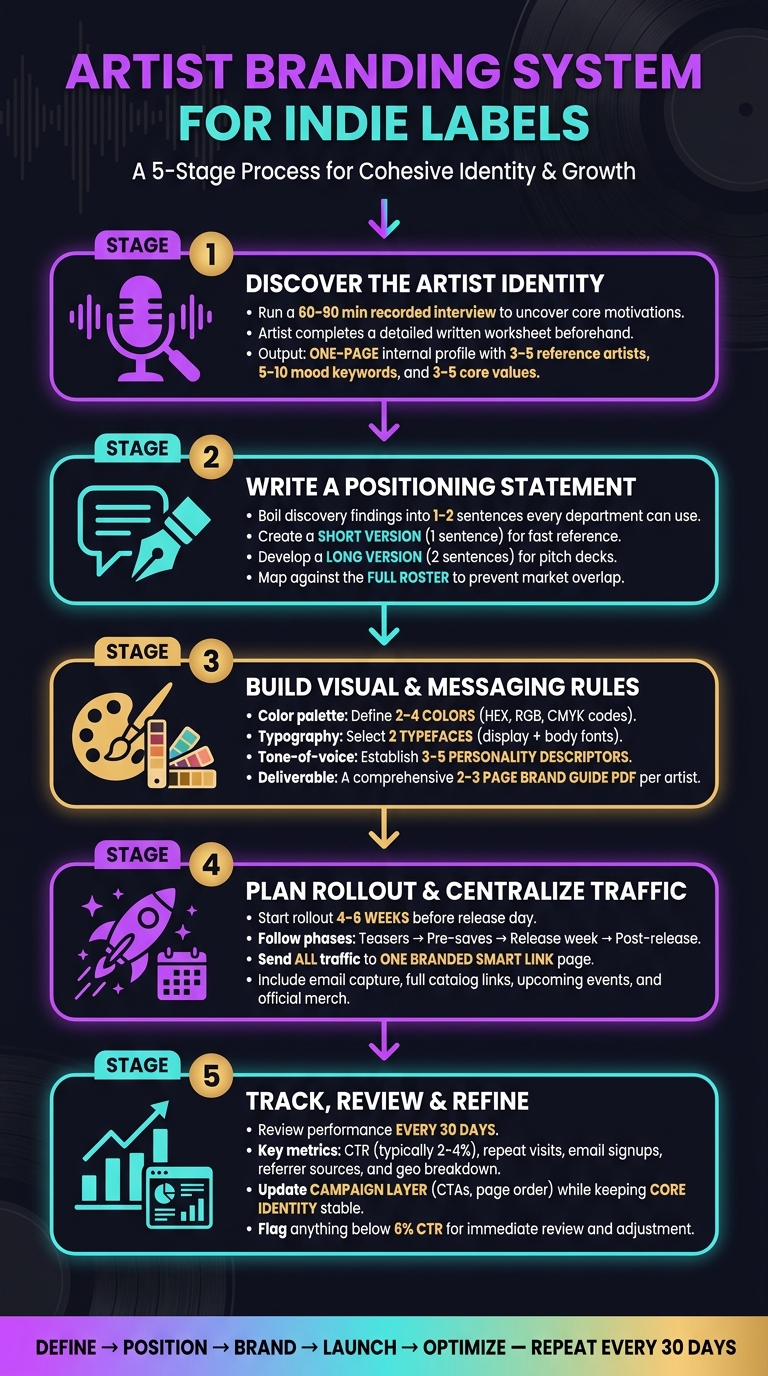
Artist Branding System for Indie Labels: Step-by-Step Process
Define each artist's identity and position on the roster
Run a discovery process before any design work
Start with discovery before anyone touches design. And go past genre labels. You want to get to the emotional job the music does.
Begin with a written worksheet the artist completes before the first meeting. Ask them to describe their sound without genre terms, point to scenes where the music would fit in a film, and name topics they don't want tied to their work. Then follow that with a recorded 60–90 minute interview and push past the first layer of answers. The point is to pin down the music's emotional promise.
Turn what you learn into a one-page internal profile for each artist. At a minimum, include:
- Core sound: genre, subgenre, and 3–5 reference artists
- Mood keywords: 5–10 words like melancholic, late-night, cinematic
- Where fans hear it most: long drives, study sessions, live shows
- A short audience snapshot
- 3–5 core values
- Signature traits
- 2–3 recurring story themes
Store that profile in a shared drive so A&R, marketing, PR, and design all work from the same source. Every brand choice later on should trace back to it.
Use this profile as the base for positioning, visuals, and release copy.
Write a positioning statement every department can use
Once the discovery doc is finished, boil it down into a positioning statement: one or two sentences that every department can use in briefs, pitches, and internal chats.
A simple framework works well: [Artist] is a [location/background] [genre/subgenre] [role] who [how they sound or what they uniquely do] for [audience description] who [what emotional or functional need the music fulfills].
A stronger version looks like this: A Nashville-born alt-country songwriter blending 90s grunge guitars with classic Americana storytelling for millennial listeners who grew up on both Nirvana and Willie Nelson. That gives you enough direction for a playlist pitch, a press angle, and a visual brief.
Keep a short version at one sentence for fast reference. Keep a longer version at two sentences for pitch decks. Then use the roster map to check for overlap.
That statement should feed straight into the roster map.
Map the roster to keep artist profiles distinct
Map the full roster against those statements so each act keeps its own lane. This is how you spot overlap before a campaign goes live.
| Column | What to Include |
|---|---|
| Core genre / subgenre | e.g., Shoegaze-influenced dream rock |
| Mood keywords | 5–10 words: hazy, nostalgic, bittersweet |
| Primary audience profile | Age range, location focus, scenes |
| Where fans hear it most | Late-night, long drives, gym, study |
| Key brand attributes | 3–5: introverted, film-nerd, anti-hype |
| Signature visual cues | Color palette, photo treatment, typography |
| Positioning statement (short) | One sentence |
| Roster role | e.g., Our festival-ready rock act |
When a new artist signs, or when someone shifts direction, update the map and compare that row against the rest. If two acts share the same mood keywords, audience profile, and visual direction, you have a problem. At that point, either tighten one artist's narrative or shift the creative direction so it leans into different influences.
The point is to spot real differences and push them forward.
sbb-itb-e819543
5 Steps to an AMAZING Artist Brand - Names, Logos, Positioning, More
Build visual and messaging rules that stay consistent
Once positioning is locked in, build two systems: one visual and one verbal. These rules help each artist feel clear and separate, while still fitting the roster map. They should show up in every fan-facing asset.
Set visual rules for photos, colors, fonts, and cover art
An artist visual system should spell out the color palette, typography, photography style, logo or wordmark use, and layout rules for streaming, social, and print. Keep the palette tight: 2–4 colors works best. That usually means one primary, one secondary, and one accent color used lightly for calls to action like "Pre-Save" or "Buy Tickets." List each color in HEX and RGB for digital, and CMYK for print pieces like posters and merch.
For fonts, stick to two typefaces: one display font for the artist name and titles, and one easy-to-read body font for bios and captions. The display font should match the artist’s tone. The body font should stay readable at small sizes on a phone screen. In the brand guide, include font names, use cases, licensing notes, and fallback system fonts.
Photography rules matter just as much as color. Set the lighting mood, color treatment, composition, and any subject-focus preferences. That way, the artist stays recognizable across press shots, social posts, streaming profiles, and live promo. It also helps to note what not to do, like image styles that clash with the artist’s identity or audience. That part saves a lot of back-and-forth later.
Pull everything into a short brand guide PDF for each artist. Two to three pages is enough. Include:
- Color codes
- Font names
- Logo spacing rules
- A one-page summary of the artist’s brand keywords and audience
- A few "use this / not this" examples
Send it to every designer, PR partner, and social manager before they make anything. Use the same standard for copy too, so the visuals and language back each other up. The same look should carry across streaming images, social headers, cover art, thumbnails, and flyers.
Create tone-of-voice rules for bios, captions, and press copy
A visual identity won’t do much if the writing sounds different every time. Start by choosing 3–5 personality descriptors for the artist, such as playful, honest, introspective, direct, or art-forward. Those words should shape every copy choice.
Then turn each descriptor into writing rules. A casual and direct artist uses short sentences, contractions, and plain language. A poetic and introspective artist leans on sensory detail and longer phrasing, but not so much that the writing gets hard to read. A polished and serious artist skips slang, uses full sentences, and focuses on craft and achievements. Add a few on-brand and off-brand examples so the difference is easy to spot.
Create short, medium, and long bios for streaming, social, press, and bookings. Use third person for press materials ("[Artist] is…") and a first-person version for platform bios ("I make…"). Keep every version in a shared folder so nobody grabs an old draft and wings it.
Also document 3–4 messaging pillars that should show up across captions, press copy, and talking points. That might include the origin story, key influences, community ties, and the current release cycle. Use U.S. English and one capitalization style for titles and credits.
"The visual continuity from the ad to the landing page adds so much value to the listener's journey." - Oren Mintz, Music Marketer
Match the tone across posters, bios, and captions so each touchpoint feels like it came from the same artist.
Plan Release Rollouts and Centralize Traffic with Branded Pages
Build Rollout Plans That Match the Artist's Identity
A release rollout isn't just a posting calendar. It's the artist's story, told step by step. And every piece in that story should feel like it belongs to the same world. The rollout should reflect how the artist is positioned, not fight against it.
For a single, a practical rollout often begins 4–6 weeks before release day. The flow is pretty simple:
- Teasers build curiosity
- Pre-saves show intent
- Release-week content drives action
- Post-release content keeps momentum going
Each phase should use the approved brand system and do one clear job. Just as important, every phase should send fans to one branded destination.
Set Up Smart Links and Artist Pages for Clarity
That rollout falls apart fast if one post sends fans to Spotify, another to Apple Music, and another to some old landing page. Too many links create friction and make tracking messy. One central destination solves both problems.
The page itself should follow a clear order. Put the current release first. Then add a few catalog highlights. After that, link to social and community channels, then events and merch when they matter. Use the positioning statement as the page bio so new visitors get the point fast.
An email capture block can sit near the top or middle of the page with simple copy like: "Get early access to new music and shows". That helps build a direct fan list. The page should feel like the artist's home base, not just a place people pass through.
PromoLinks.me supports branded smart links, pre-save redirects, QR codes, event pages, and fan email capture in one place. For shows and listening parties, dedicated event pages can use the artist's imagery and typography so the look stays consistent. QR codes tied to those pages also work well on flyers and merch, sending fans back to that same branded page.
Keep Naming and Page Templates Organized Across Campaigns
When a label is juggling multiple artists with release dates close together, messy file names can turn into a headache. Clear naming keeps one artist's assets from drifting into another campaign. A steady internal naming system helps avoid duplicate files, wrong versions going live, and wasted time hunting for the right asset.
A simple format works well:
- Releases:
[ArtistName]_[ProjectType]_[Title]_[YYYYMMDD]
Example:NovaRay_Single_MidnightDrive_20260721 - Smart links:
[ArtistName]_[CampaignType]_[ProjectTitle]_[Platform] - Visual assets:
[ArtistName]_[AssetType]_[Title]_[AspectRatio]_[Version]
Folder structure should match that system too: one top-level folder per artist, then subfolders by year and campaign.
Use the same page layout across campaigns, then swap in each artist's approved colors, type, and imagery. Change the microcopy to fit their tone. A punk act might use blunt, direct language. A neo-soul artist might lean warmer and more intimate. PromoLinks.me's customizable templates make this much easier: clone a layout that already performs well, then tailor it for each artist instead of rebuilding every page from scratch.
Review Analytics, Update the Brand, and Keep the Roster Clear
Track Which Pages, Visuals, and Messages Perform Best
Track the signals that show whether each artist is coming across the way you want: page engagement, clicks, signups, and repeat visits. Those numbers tell you a lot. They show which artist pages get the most attention, which bios or captions earn clicks, and which visuals or messages connect with certain audiences. CTR is the fastest gut check for whether the brand is clear enough to get someone to act.
CTR is the clearest quick check: 2–4% is typical, while anything below 6% needs review. Repeat visits and email signups matter too, because they point to ongoing interest instead of a one-off click.
PromoLinks.me's analytics dashboard lets labels view page views, link clicks, unique visitors, CTR, referrers, geo breakdown, and device breakdown across multiple time windows, including Today, 3 days, 7 days, 14 days, 30 days, and All. The dashboard also lets labels compare release links and artist hubs without switching tools. That side-by-side view shows more than what converts. It also shows where each artist's audience is coming from. For U.S.-focused campaigns, geo breakdown by state and city can help guide touring, local PR, and targeted ad spend.
Use referrer data to line up each artist's page, CTA, and content format with the traffic source. If one artist gets most of their traffic from TikTok and another gets it from email, those are two different audience journeys. Their pages and content formats should match that. Different referrer patterns are a strong reason to use different CTAs, and that's one of the simplest ways to keep artist campaigns separate across the roster.
Set a Monthly Review Process for Each Artist
Review the last 30 days of artist page and smart link data, then check CTR, top regions, email growth, and redirect accuracy. Then look past the numbers for a minute and ask a simple question: does the page still match where the artist is now?
The core identity - positioning, visual rules, and tone of voice - should stay steady. What should change more often is the campaign layer: page order, CTA copy, and campaign emphasis. Frequent rebrands blur recognition. Small, data-led updates help keep the artist clear without rebuilding everything every cycle. Use what you find to tune the system, not wipe the slate clean.
Conclusion: Build a System, Not Just a Look
Strong artist branding is not a one-time design project. It's a repeatable system for managing a roster. Labels keep artists clear by defining identity first, centralizing traffic, and making focused updates based on real data.
Each part supports the next. A clear positioning statement makes visual choices easier. Consistent visuals make analytics easier to read because you can tell which artist's page is which. And regular reviews help stop the roster from blending together as it grows.
FAQs
How do we brand similar artists differently?
Focus on each artist’s mood, then shape the artist page so it matches the sound.
With PromoLinks.me, you can pick different templates and pull colors straight from each artist’s cover art. That way, each page feels personal instead of looking like the same generic layout with a new name slapped on it.
What should stay fixed between releases?
Keep your core brand elements the same across every release:
- Artist name that matches your DSP profiles exactly
- Typography, color palette, and background elements
- Your PromoLinks smart link and artist page structure
When you use the same landing page, hero image, social links, and call-to-action layout each time, people start to recognize your catalog faster. It also helps build trust, because everything feels connected instead of pieced together.
Which metrics matter most each month?
Focus on quality metrics, not vanity counts like total streams or monthly listeners.
What matters more is whether people stick with your music and come back for more.
- Save rate: aim for 15%+
- Stream velocity: shows how fast your tracks are gaining momentum
- Listener-to-follower conversion rate: aim for 20%+
- Traffic sources: about 40% of streams should come from algorithmic recommendations, not just playlists
A song with fewer streams but a strong save rate can be in a much better spot than one with a big stream count and weak listener action. The same goes for follower conversion. If people listen but don’t follow, that’s a sign your music may be getting plays without building a fan base.
Related Blog Posts
Ready to create your smart links?
Join thousands of artists using PromoLinks to promote their music smarter.
Get Started Free