How Many Singles to Release Before an Album
How Many Singles to Release Before an Album
If you want the short answer: I’d start with 2 to 4 singles before an album, and 3 is the safest default for most full-length releases.
That range gives you enough time to build streams, test which songs connect, and stay in front of listeners without making album day feel like old news. This is where running a pre-save campaign becomes essential to lock in engagement early. If you put out more than half the album ahead of time, the full release can lose impact.
Here’s the simple breakdown:
- 1–2 singles: best for EPs, short timelines, or lower budgets
- 3 singles: the standard pick for many albums
- 4 singles: works if you have enough time, money, and promo support
- 5+ singles: usually better for longer campaigns, bigger tracklists, or genres that lean on frequent drops
A few numbers matter most:
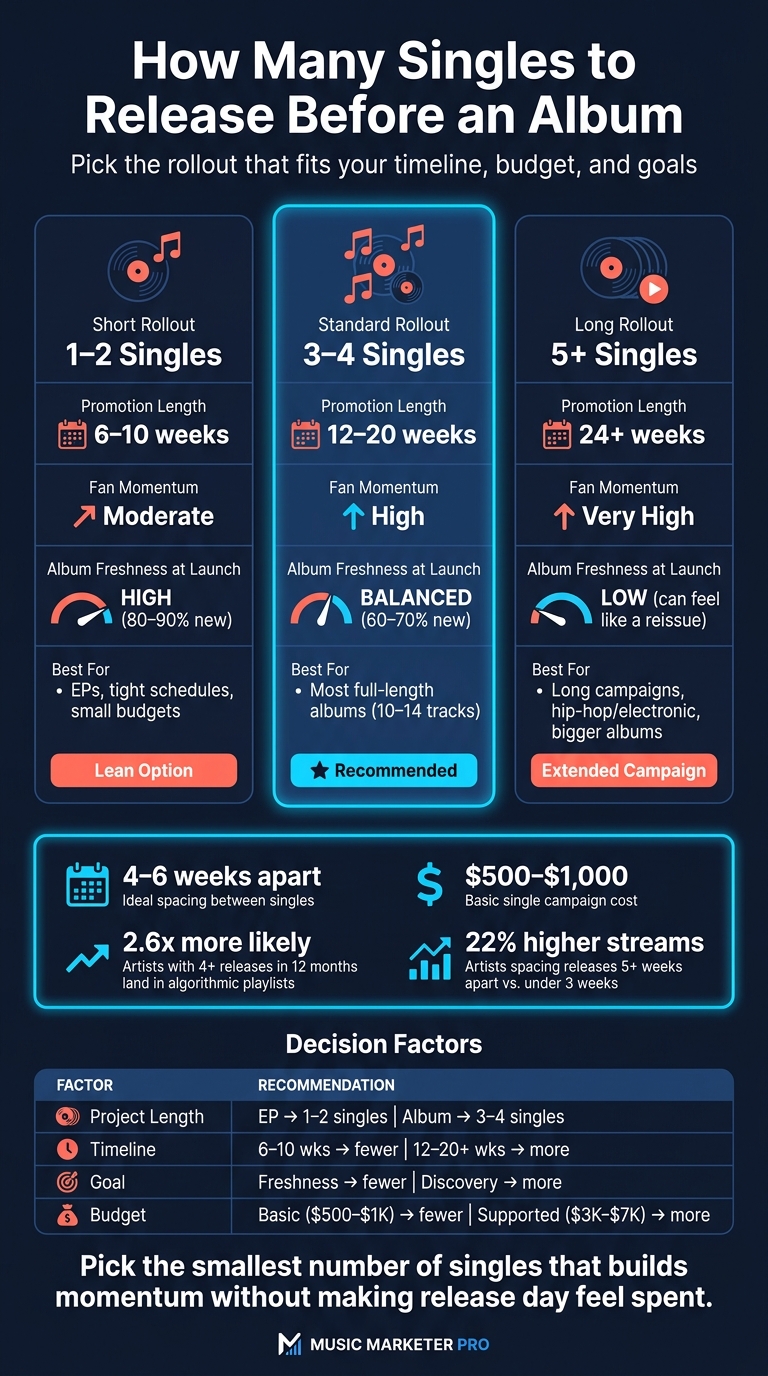
- Space singles about 4 to 6 weeks apart
- A 3-single rollout often needs about 12 to 16 weeks
- A 4-single rollout can run 20+ weeks
- Artists with 4 releases in 12 months are 2.6x more likely to land in algorithmic playlists than artists with only 1 or 2 releases
- A basic single push can cost about $500 to $1,000, while a bigger indie push can run $3,000 to $7,000
How Many Singles to Release Before an Album: Rollout Guide
How many singles should be in your album rollout? 10/12 songs? 4/12 songs?s
sbb-itb-e819543
Quick comparison
| Rollout | Best for | Time needed | What you keep for album day |
|---|---|---|---|
| 1–2 singles | EPs, tight schedules, small budgets | 6–10 weeks | Most of the project unreleased |
| 3–4 singles | Most albums | 12–20 weeks | A solid mix of known and unreleased songs |
| 5+ singles | Long campaigns, bigger albums, heavy-release genres | 24+ weeks | Less left unheard before launch |
My rule: pick the smallest number of singles that gives you enough momentum without draining the album before release. This strategy works best when paired with a comprehensive music promotion plan across all platforms.
The Practical Range: Most Albums Work Best With 2 to 4 Singles
For most albums, 2 to 4 singles is the sweet spot.
If you want the cleanest default, go with three singles. On a 10-track album, that means 7 of the 10 songs are still unreleased when the album drops. You get enough runway to build momentum without giving away the whole record.
The tradeoff is pretty simple: more singles give you more promo windows and more platform data, but they also leave fewer unreleased songs to hit listeners with on album day. So the right number comes down to this: do you need more discovery, or do you want more surprise left in the tank?
When 1 to 2 Singles Make Sense
A shorter rollout works well when time is tight, money is limited, or you want the album to land with as much first-day impact as possible. It keeps most of the music under wraps, but it also gives platforms less time to figure out who should hear your songs.
This is the lean option. Not the big, stretched-out one.
When 3 to 4 Singles Make Sense
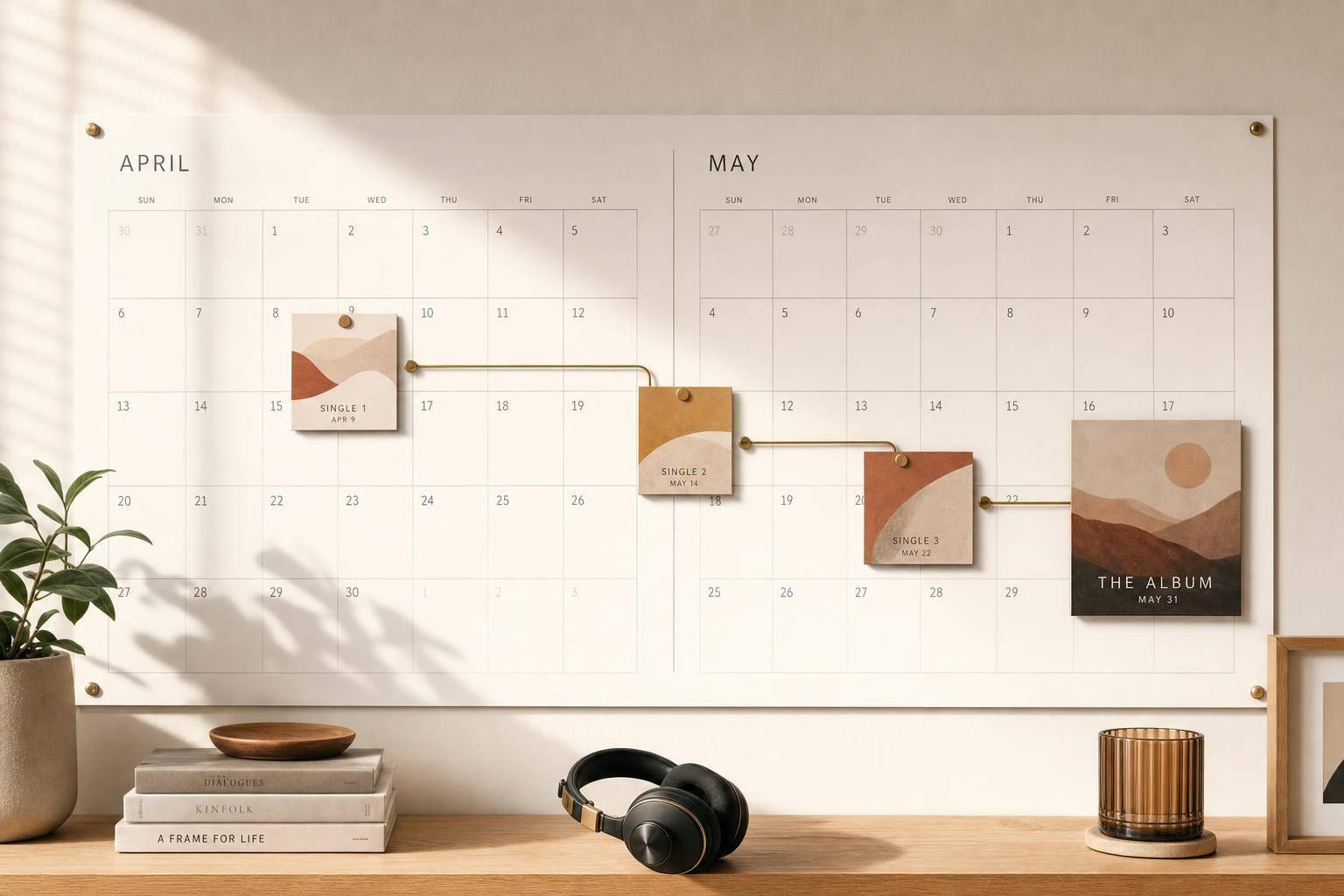
For a standard 10-track album, 3 to 4 singles is where many independent campaigns end up. Each single creates its own promo cycle, and spacing them 4 to 6 weeks apart helps you stay visible without wearing people out.
This range also gives your team some room to adjust. If an early single doesn't hit the way you hoped, you still have time to shift ad spend or use music promotion tools to change the creative before the album arrives.
When 5 or More Singles Can Work
A longer rollout - 5 or more singles - can work for bigger albums, genres that do well with frequent drops like hip-hop and electronic music, or campaigns where staying visible for 6+ months matters more than keeping the album mostly unreleased.
But there's a clear downside. Once more than half the album is already out, release day can start to feel less like a new event and more like a reissue.
Use these ranges as a starting point, then match the count to your album, budget, and timeline.
Use this quick comparison to pick the rollout shape that fits your campaign.
| Rollout Type | Promotion Length | Fan Momentum | Album Freshness at Launch |
|---|---|---|---|
| Short (1–2 Singles) | 6–10 weeks | Moderate | High (80–90% new) |
| Standard (3–4 Singles) | 12–20 weeks | High | Balanced (60–70% new) |
| Long (5+ Singles) | 24+ weeks | Very High | Low (can feel like a reissue) |
How to Choose the Right Single Count for Your Album
The right count depends on five things: project length, timeline, campaign goal, audience size, and budget.
Match the Single Count to Album Length and Timeline
Project length sets the upper limit. Short EPs usually work best with 1 to 2 singles. Full albums usually have room for 3 to 4. If your EP has 4 to 6 tracks, dropping more than 2 singles before release can give away too much. But a full-length album with 10 to 14 tracks gives you enough space for 3 to 4 singles without making release day feel like a repackage.
Timing matters too. Each single usually needs 4 to 6 weeks to build traction before the next one lands. So a 3-single rollout often needs 12 to 16 weeks of lead time. A 4-single campaign can stretch past 20 weeks. If your release window is short, a 1- to 2-single rollout is usually the safer move.
Use Campaign Goals to Decide Between Discovery and Freshness
Your goal changes the equation.
If you're a newer artist or still building an audience, more singles can help with discovery. Artists who release at least four tracks within a 12-month period are 2.6 times more likely to show up in algorithmic playlists than artists who release only one or two.
But if you're more established, or you're putting out a concept album where the full listen matters, fewer singles can protect that moment. Once you release more than 50 to 60% of an album before launch, the album can start to feel less like an event and more like a repackage.
Factor In Budget and Audience Size
Budget puts limits on everything. A basic single campaign usually costs about $500 to $1,000. A fully supported push with video, PR, and marketing can land between $3,000 and $7,000.
For smaller acts with tight budgets, it's usually smarter to release fewer singles with more support than to spread your money too thin. Say your total promo budget is around $600. Putting $100 in Meta ad spend behind each of 6 tracks will outperform putting $50 behind 12 tracks. A good floor is $75 to $100 per single on paid ads so the platform's algorithm has enough data to optimize delivery.
Use the table below as a quick shortcut.
| Factor | Fewer Singles (1–2) | More Singles (3–4) |
|---|---|---|
| Project length | EP (4–6 tracks) | Album (10–14 tracks) |
| Timeline available | 6–10 weeks | 12–20+ weeks |
| Primary goal | Preserve album freshness | Maximize discovery |
| Audience size | Established fanbase | Small/new or growing audience |
| Budget | Basic budget ($500–$1,000) | Fully supported indie budget ($3,000–$7,000) |
Once the count is set, map each single to the rollout calendar.
What a Pre-Album Release Schedule Should Include
Once you know how many singles you’re putting out, assign each one a date and a job. Every release should do something for the album, not just fill space on the calendar.
A Simple Rollout From Lead Single to Album Release
Your lead single sets the tone for the entire campaign. It should build momentum for what’s next, not burn through your best song too soon. Pick a track that reflects the album well, and if needed, hold back stronger cuts for later.
A good rule of thumb is to space singles 4 to 6 weeks apart. That gap gives each release time to breathe before the next one lands. If singles come out too close together, the newer one can kill the momentum of the last one. And the numbers back that up: artists who leave at least 5 weeks between releases see a 22% higher average in first-week streams than artists who drop a new track within 3 weeks of the previous one.
After you lock the number of singles, map them to the calendar.
| Phase | Timing | Key Action |
|---|---|---|
| Setup | 10–12 weeks before album | Finalize masters, artwork, and upload Single 1 to distributor |
| Lead Single | 8–10 weeks before album | Release Single 1; start pre-save for the next release; pitch to editorial |
| Follow-up Single | 4–6 weeks before album | Release Single 2; announce the album and tracklist |
| Album Announcement | 2 weeks before album | Reveal cover art; launch album pre-save |
| Release Day | Week 0 | Full release; update all smart links to the live album |
One timing detail matters a lot: submit tracks to your distributor at least 4 weeks before release. That gives enough time for processing and for pitching prep.
Track Campaign Data From One Hub
Once the dates are in place, the next step is simple: watch which single is pulling people toward the album. A rollout looks good on paper, but the data tells you what’s working.
Use one smart-link hub for pre-saves, QR codes, and email capture across the full rollout. Then track the signals that matter most, like saves, clicks, and first-48-hour streams for each release.
"Saves are the most valuable algorithmic signal." - Florencia Flores, NotNoise
Check the results from each single before the next one goes live.
Final Answer: Pick a Single Count That Supports the Album
After weighing the timeline, budget, and audience size, the simplest rule is this: pick the number of singles that helps the album’s story and still leaves enough unreleased songs for launch day.
Album day should still feel new. That means holding back enough music so listeners have something fresh to dive into when the full project arrives.
Use this rule to shape the rollout:
Key Takeaways for Artists and Labels
Using shareable music links ensures fans can access your singles on any platform during the rollout.
- 2 singles: best for EPs, short timelines, or tighter budgets.
- 3 singles: the default choice for most albums.
- 4 singles: only if the campaign has enough time and budget to carry them.
Space each release about 4 to 6 weeks apart, and line them up so the strongest final single lands right before the album drops, often supported by pre-save campaigns to maximize day-one impact.
Pick the smallest number of singles that builds momentum without making release day feel spent.
FAQs
Does genre change how many singles I should release?
Not really. Genre doesn’t give you a set number for how many singles to release. A better way to decide is to look at your project’s goals, your audience, and what you want the release to do.
Some electronic and experimental artists put out fewer singles because the album is meant to land as a full statement, not a series of preview tracks. And that can apply in any genre. The goal is simple: release enough singles to support the music, but not so many that the album feels too familiar before it’s out.
Which song should I pick as the lead single?
Pick a song that clearly shows the album’s sound and sets the tone for the project. It doesn’t need to be your strongest track.
A lot of the time, it’s smarter to hold back your most commercial song for a later single. That way, you can build momentum as the release rolls out. Then the second or third single can hit harder and show more of your range.
Should I release fewer singles if my album has only 8 tracks?
Yes. For an 8-track album, three to five singles is usually the sweet spot.
That gives you room to build momentum and see what lands with your audience, while still holding back enough unreleased songs so the album feels fresh when it drops.
A good rule of thumb: try not to put out more than half the tracklist as singles. If you do, the album can start to feel a little too familiar.
Related Blog Posts
Ready to create your smart links?
Join thousands of artists using PromoLinks to promote their music smarter.
Get Started Free