How Pre-Save Campaigns Help Playlist Promotion
How Pre-Save Campaigns Help Playlist Promotion
Pre-saves can help your song get more playlist traction by stacking fan action on day one. If you launch the link 14 to 21 days before release, pitch Spotify at least 7 days early, and push fans back to one page, you give both algorithms and curators more reason to pay attention.
Here’s the short version:
- Pre-saves front-load saves instead of letting them trickle in after release.
- Songs with 200+ pre-saves can see 40% to 60% more first-week algorithmic playlist adds than songs without a campaign.
- A short campaign often underperforms. Running it for 2 to 3 weeks can bring in far more pre-saves than a campaign under 10 days.
- Email usually converts better than social, while social helps drive reach.
- Your job doesn’t end at release. You need to check pre-saves, day-one streams, and playlist pickup in the first week.
I’d treat a pre-save campaign as a simple system:
- Follow a music marketing checklist to set the timeline early
- Build one clear pre-save page
- Push one link across email and social
- Use the numbers in playlist pitches
- Check what turned into streams and playlist adds
The main point is simple: pre-saves help playlist promotion when they lead to real release-day listening. That means timing, one clear link, steady promotion, and a strong follow-up once the song is live.
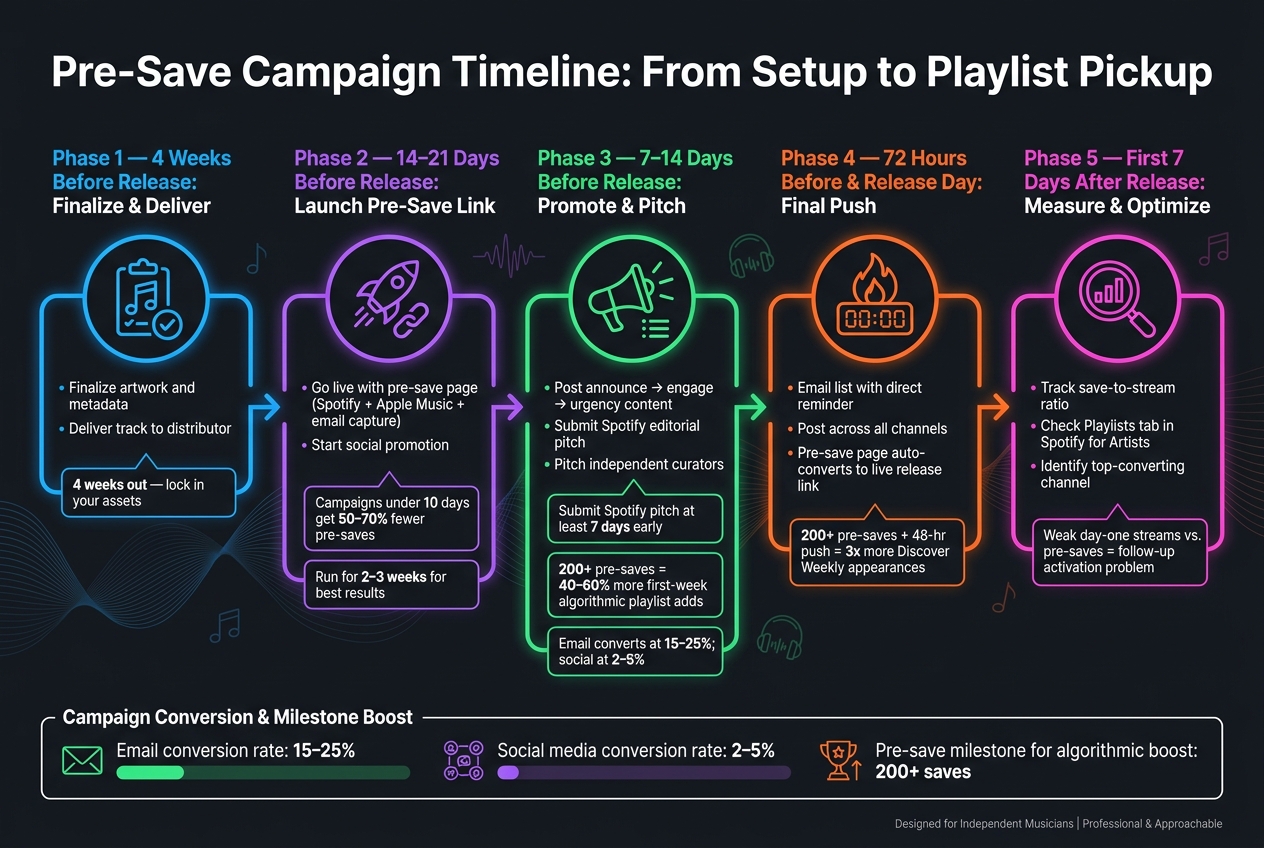
Pre-Save Campaign Timeline: From Setup to Playlist Pickup
Create a Spotify Pre save campaign (In less then 8 minutes)
sbb-itb-e819543
Step 1: Set up the release and launch the pre-save link early
Before you promote anything, finish the release setup first. A pre-save campaign can only go live after the track has been sent to your distributor and processed far enough to generate the Spotify link data your pre-save tool needs.
Confirm the release timeline and distributor delivery
The safest flow looks like this: finalize your artwork and metadata at least 4 weeks before release, send the track to your distributor 2 to 4 weeks ahead, launch the pre-save link 14 to 21 days before release, and submit your Spotify editorial pitch at least 7 days before release.
That timing matters. Campaigns that run for fewer than 10 days usually get 50% to 70% fewer total pre-saves than campaigns that run for 2 to 3 weeks.
Once the link is live, your promo gets a lot simpler. Every social post, story, and playlist pitch can send people to the same place.
Create a pre-save link fans can use in one tap
Once your link data is ready, the page itself needs to be easy to use. Most fans will open it on their phones, so every extra step can hurt conversions.
PromoLinks.me lets you build a mobile-ready pre-save page that includes Spotify, Apple Music, and other platforms in one link. It also collects fan emails and gives you real-time analytics, so you can track clicks and saves before release day. Use that same link across every post, story, and bio update so fans always land in one place.
With the link ready, the next move is getting more of those clicks to turn into pre-saves.
Step 2: Build a clean landing page that turns visits into pre-saves
Clicks matter only if the landing page turns them into pre-saves. A focused page helps turn social traffic into day-one saves, and those early saves can help your playlist pitches look stronger. Every extra pre-save gives your outreach more proof that people want the release.
Keep the page focused on the release
A high-converting pre-save page should do ONE thing: get the fan to tap the button.
So keep the page tight. Include the official release artwork, your artist name, the release date, and one clear call-to-action button.
One page. One action. Cut old links and extra options.
That simple setup makes your social posts easier to turn into pre-saves.
Use PromoLinks.me features to improve conversion and tracking
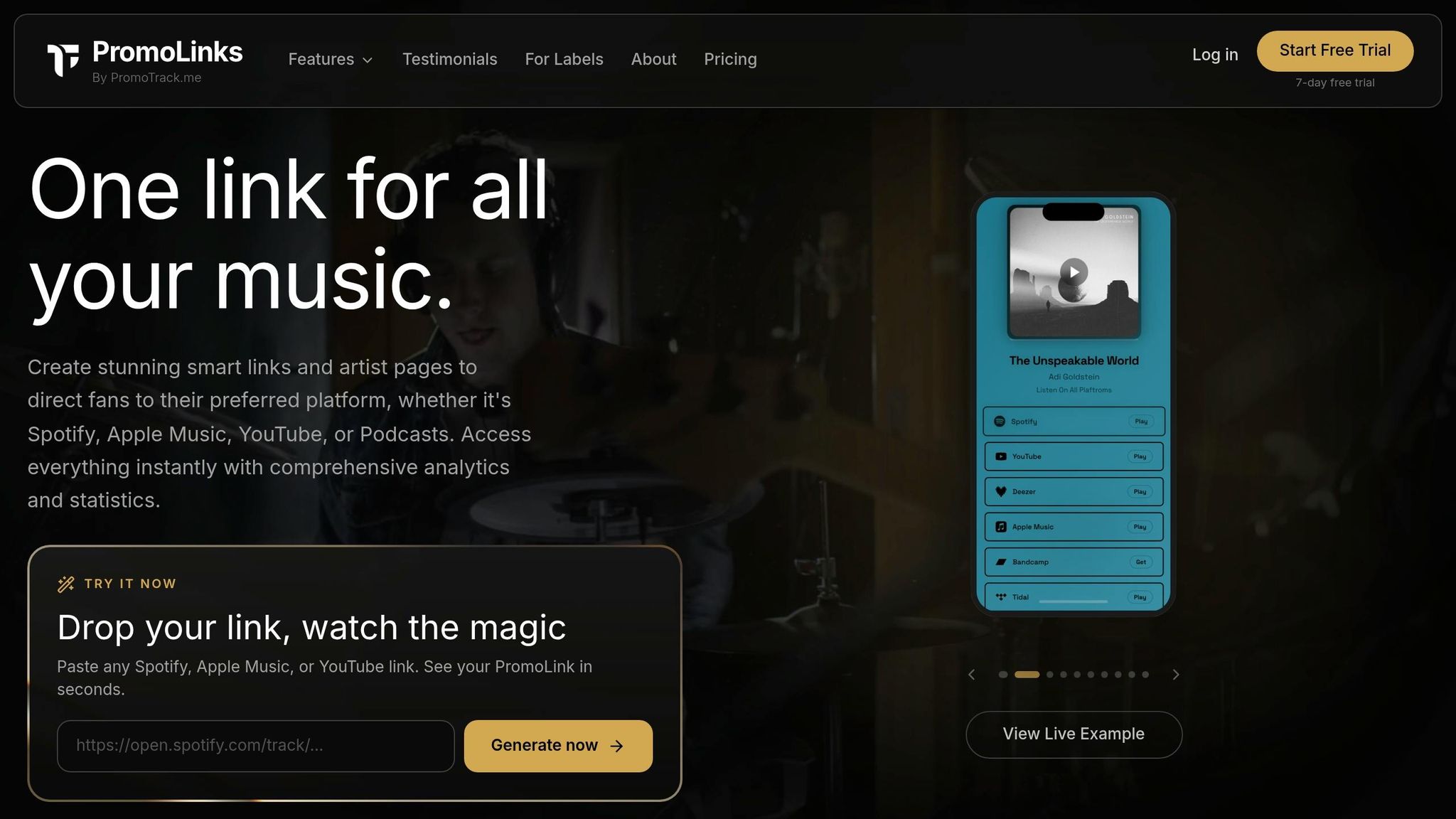
PromoLinks.me works well for this kind of pre-release page. Use a mobile-first PromoLinks.me page with a matching template, audio preview, email capture, pixel tracking, and QR code access.
Those details matter. Fans who click a pre-save link from a mailing list complete the action at a rate of 60% to 80%, while social media traffic usually converts at just 2% to 5%.
Real-time analytics let you see daily clicks and pre-saves. On release day, PromoLinks.me switches the pre-save page into a live release link, so the same URL you’ve been pushing keeps working with no extra setup.
Place the link where fans already spend time
Use the same link across your main social profiles and email. Set the pre-save page as the main link in your Instagram bio, TikTok profile, YouTube channel description, and pinned YouTube comments. Add it to your email signature during the pre-release window too.
Email is your strongest organic channel by a wide margin, with conversion rates usually landing between 15% and 25%. Social posts and Stories still matter because they drive reach. But think of them as traffic sources that send fans back to the same landing page, not as the place where most conversions happen.
Once the page is live, use social content to send people there and build the early activity that helps support playlist pitching.
Step 3: Promote the pre-save on social media and connect it to playlist pitching
Once your landing page is live, the job shifts to traffic. Over the 2 to 4 weeks before release, keep sending people to that page and keep the pace steady. This pre-release stretch is where momentum starts to show.
Run a simple pre-release posting schedule
Every post should point fans to the same pre-save link. Don’t make people hunt for it.
A simple way to handle the pre-release window is to split it into three phases: announce, engage, urgency. In the first week, share the artwork reveal and the main announcement post. In the second week, lean into engagement content like 15-second audio teasers, behind-the-scenes studio clips, and lyric snippets. Then, in the final week, switch to countdown posts and direct reminders.
Each platform should do a different job:
- Instagram Stories for direct clicks
- TikTok for reach
- YouTube Community posts for warm subscribers
In the final 72 hours, push hard. Email your list with a direct reminder, and post across every active channel.
Give fans a clear reason to pre-save now
“Pre-save my song” is too vague. It doesn’t answer the one thing fans are silently asking: Why now?
Give people a reason to act today instead of waiting for release day. Frame the ask around what they get: "Be the first to hear it," "Unlock exclusive drops," or "Get early access to unreleased content." That’s what makes the offer work. It turns a passive ask into a clear exchange.
If you want more conversions, add something people can point to. A merch giveaway for anyone who DMs a screenshot of their pre-save, early access to an acoustic version, or a private Discord invite can all push more action now instead of later.
Repeat the same offer across platforms, but change the format so it doesn’t feel stale. And use that same offer in your curator pitch too. When the fan-facing message and the outreach message match, the whole campaign feels tighter.
Line up pre-save activity with playlist outreach
As your pre-save numbers climb, start sending pitches while that growth is still happening.
Submit your Spotify for Artists editorial pitch 2 to 4 weeks before release, lining it up with the high point of the pre-save campaign so editors can see interest building in real time. If an editor checks your profile while reviewing the pitch, you want them to see movement, not an empty page.
The same idea applies to independent playlist curators. Lead with numbers. A pitch that says you picked up 250+ pre-saves in 10 days lands harder than a generic submission with no proof behind it.
Tracks that hit 200 or more pre-saves see 40% to 60% higher first-week algorithmic playlist inclusion compared to releases with no campaign. That makes 200 pre-saves a smart milestone to plan your outreach around.
Step 4: Review results after release and measure playlist impact
The last step is simple: check whether your pre-release push turned into playlist traction.
Once the track goes live, watch the first 7 days closely. That first week tells you a lot. You’ll see whether the campaign led to actual listening, early saves, and playlist movement, or whether the buzz faded after release day.
Compare pre-saves, first-day streams, and early playlist signals
During the first 7 days, line up your pre-saves, first-day streams, and early playlist movement. That’s how you tell if release-day interest turned into real listening.
If first-day streams come in well below your pre-save count, that can point to visits that didn’t turn into pre-saves.
Here are the main metrics to pull from Spotify for Artists in week one, and what each one says about playlist traction:
| Metric | Playlist Signal |
|---|---|
| Save-to-Stream Conversion | If first-day streams lag behind pre-saves, release-day activation needs work; strong save-to-stream follow-through is a key signal for algorithmic support |
| Release Radar Expansion | Shows reach beyond your current followers from day one |
| Early Momentum | Helps show how fast Spotify starts testing the track with new listener groups |
| Email/Data Capture Rate | Gives you a direct way to promote the next release |
Don’t look at any one metric by itself. Put them together. That gives you a better read on whether the campaign is building the kind of momentum that playlists tend to reward.
Around day 7, check the Playlists tab in Spotify for Artists to see whether algorithmic playlists have started picking up the track. Artists who pair 200+ pre-saves with a planned 48-hour release push get 3x more Discover Weekly appearances in the first month than artists who don’t.
Use the data to improve the next campaign
Use your first-week data to figure out which channel, message, and send time should get more attention on the next release.
Start with the channel that drove pre-saves, not just clicks. That part matters. A post can get traffic and still fall flat if people don’t finish the action. Your analytics can show whether Instagram, TikTok, or your email list converted best. Put more effort there next time.
"If half your pre-savers are not streaming on day one, your follow-up activation is weak. The pre-save is the top of the funnel. Your release-day messaging must convert those saves into actual engagement." - Chartlex
If pre-save numbers looked strong but day-one streams were soft, the problem is often weak release-day follow-through, not the campaign itself. If your landing page got a lot of traffic but few completed pre-saves, that points to friction you should fix before the next release. Use the top-performing channel and send time to guide the next campaign.
Conclusion: What to take from each pre-save campaign
Pre-saves only work when timing, social promotion, and release-day follow-through all line up.
Once the song is out, the numbers show what the campaign actually delivered. You can see which channel converts, how fans follow through on release day, and whether playlist pitching led to playlist traction. The pattern matters more than the total.
Key takeaways for the next release
- Use PromoLinks.me to collect fan emails alongside pre-saves. That list can become one of your most reliable assets for the next rollout.
- When you pitch to curators, lead with your pre-save total. A specific number usually lands harder than a broad description of the track.
- Track real-time analytics like the pre-save-to-day-one stream ratio to spot weak follow-through.
Use those patterns to sharpen the next pre-save push.
FAQs
Do pre-saves help small artists too?
Yes - pre-save campaigns can work for small artists if you already have a warm audience and a real release moment to build on.
But let’s be clear: they’re not a shortcut to algorithmic success.
Their main value is pretty simple:
- Building early momentum
- Supporting Release Radar distribution
- Signaling listener interest to Spotify
- Capturing email addresses so you own your fan data
If you don’t have an audience yet, consistent pitching seven days before release may work better.
What if my pre-saves do not turn into streams?
If pre-saves don’t turn into streams on release day, that can send the wrong message to streaming algorithms. Instead of reading that activity as hype, they may read it as low listener interest.
That’s why pre-saves should be the start of a 48-hour release funnel, not the end of it. When release day hits, follow up fast through email, social media, or direct messages to push those fans from intent to action.
PromoLinks.me helps with this by letting you capture fan emails, so you have a direct way to reach people when the song goes live.
When should I start playlist pitching?
Start playlist research 6–8 weeks before release. That gives you enough time to find playlists that fit your sound instead of rushing and sending random pitches.
Pitch user-generated playlists 4–6 weeks out. A lot of curators need lead time to review tracks and plan their adds, so late outreach can cost you a shot.
For Spotify editorial, submit through Spotify for Artists at least 7 days before release. If you can, aim for 14–21 days ahead. That window gives your track more time to be reviewed.
Launch your pre-save campaign 2–3 weeks before release so you have time to build momentum before the song goes live.
Related Blog Posts
Ready to create your smart links?
Join thousands of artists using PromoLinks to promote their music smarter.
Get Started Free