
Music Covers, Clips, and UGC Rights
Music Covers, Clips, and UGC Rights
Most fan music posts are not judged by intent. They’re judged by what you used and how you used it.
If I had to boil this article down to one takeaway, it’s this: a cover, a dance clip, a reaction, concert footage, and a meme can all use the same song but trigger very different rights problems. In many cases, the key split is between the song itself and the recording of that song. Add video, branding, or paid use, and the risk often goes up fast.
Here’s the short version:
- Covers are usually the lowest-risk format, especially for audio-only posts with the right license.
- Dance clips often lean on platform music deals, but that usually works best for personal use, not brand posts.
- Reaction videos may have a stronger fair use argument when your commentary leads and the source clip stays limited.
- Concert footage is one of the riskiest formats because it can involve music rights, ticket terms, and people’s likeness all at once.
- Memes and remixes may look casual, but editing or reposting protected material can still lead to muting, claims, or takedowns.
- Giving credit is not permission.
- Posting on one app does not mean you can repost it everywhere else.
A few points matter across all five formats:
- There are often 2 main copyrights in play: the musical composition and the master recording.
- Platform systems like Content ID and audio matching tools can act on uploads automatically.
- Commercial use is usually a turning point. A post that stays up on a personal account can become a problem when tied to a product, sponsor, or ad.
- There is no fixed “safe” clip length that clears rights by itself.
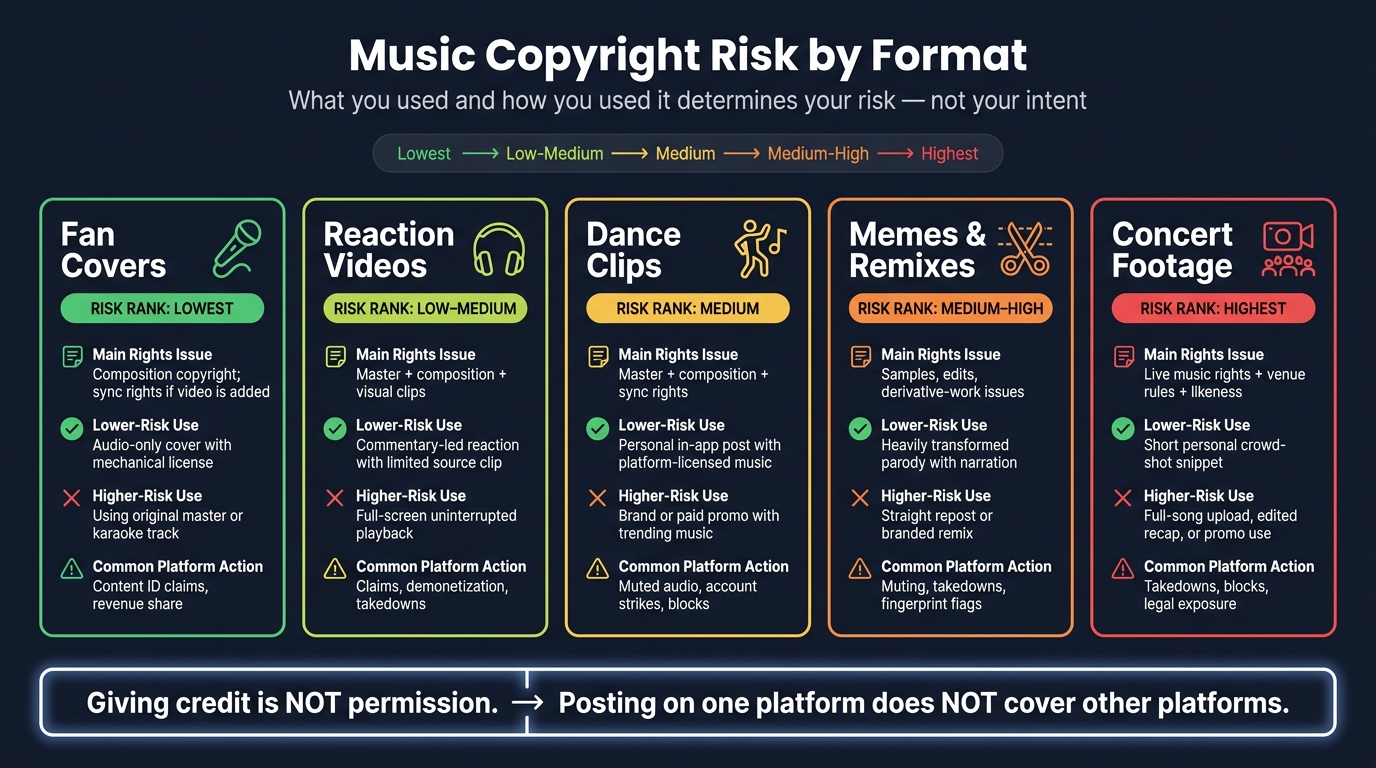
Music Copyright Risk by Format: Fan Covers vs. Dance Clips vs. Reactions vs. Concert Footage vs. Memes
Music Copyright Needs an Overhaul – Here’s How
Quick Comparison
| Format | Main rights issue | Lower-risk use | Higher-risk use | Common platform action |
|---|---|---|---|---|
| Fan covers | Composition; video adds sync | Audio-only cover with proper license | Using the original track or altered lyrics | Claims |
| Dance clips | Master + composition + sync | Personal in-app post | Brand or paid promo with trending music | Muting, blocks |
| Reaction videos | Master + composition + video clips | Commentary-led reaction | Full-playback or clip-heavy post | Claims, takedowns |
| Concert footage | Live music rights + ticket rules + likeness | Short personal snippet | Full-song upload or promo recap | Takedowns, blocks |
| Memes/remixes | Samples, edits, derivative-use issues | Heavily changed personal meme | Straight repost or branded remix | Muting, takedowns |
In plain English: the less original protected material I use, and the more my own input leads the post, the lower the risk tends to be. Once I use the original recording, post full clips, edit source material, or tie the post to money, the chance of a claim goes up.
1. Fan cover songs
A fan cover means re-recording the song itself rather than using the original master recording. That sounds simpler, and in most cases it is. But the song's writers and publishers still own protected rights in the composition.
That's why covers are often the lowest-friction type of fan-made music use. The big dividing line is simple: audio-only vs. video. That one difference changes the license path.
Rights implicated
Every cover uses the composition copyright. If you add video, you also need sync rights.
And if you go beyond a straight cover, things get stricter. Change the lyrics, translate the song, or make major edits to the melody or structure, and you need direct permission from the copyright holder. As TikTok's Music Terms of Service state:
"You can not edit or alter the fundamental character of any copyrighted music, unless you created the underlying music or otherwise have the rights or permissions to do so."
Typical licensing path
For audio-only covers sent to streaming platforms, U.S. copyright law usually allows a compulsory mechanical license. In plain English: the publisher usually can't just block the cover, but you still have to pay the statutory royalty.
Services like Songfile (Harry Fox Agency) and Easy Song Licensing can handle that filing.
For cover videos, the picture is messier. A platform's blanket deal may cover some personal, noncommercial uses. But that often does not extend to business accounts.
Claim risk
One mistake trips people up all the time: don't sing over the original instrumental or karaoke track. The second you do that, you're no longer dealing only with the composition. You're now using the master recording too.
On YouTube, even allowed covers can still trigger Content ID claims. If you're in the Partner Program, that can mean ad revenue gets split with the publisher.
Cover format comparison
| Cover Format | Primary Rights Involved | License Path | Claim Risk | Business-Use Risk |
|---|---|---|---|---|
| Audio-Only Cover | Composition copyright | Compulsory mechanical license | Low, if royalties are paid | Moderate |
| Cover Video (UGC) | Composition + sync rights | Platform blanket deal / revenue share | Moderate; claims are common | High |
| Translated/Altered Cover | Adaptation / derivative rights | Direct permission from songwriter/publisher | Very high; often blocked or muted | Extreme |
Once fans start using the original recording or pair the song with video, the legal risk tends to jump fast.
2. Dance clips with copyrighted music
Unlike covers, dance clips usually use the original master recording. That means the risk can jump fast, especially once the post is public or tied to a brand.
Most dance clips combine choreography with a recorded song. In plain English, that can trigger composition rights, master rights, and sync rights all at the same time.
Rights implicated
For dance clips, sync rights are usually the main issue. In practice, that often leaves you with two safer paths: use pre-cleared music from the platform or get a direct license.
Choreography can add another layer too. If the dance is original enough, it may bring its own rights questions. Common moves and basic steps, though, usually don't qualify.
Typical permission need
Short, personal clips made inside the app may fall under platform licenses. But once a post is branded, paid, or linked to a product, the bar goes up.
For commercial posts, use music from the platform's Commercial Music Library or get a direct license. That's usually the cleanest route.
Claim and removal risk
Platforms use audio fingerprinting tools to spot copyrighted music. If the system finds a match, the result can be:
- monetization by the rights holder
- muted audio
- account strikes
- takedowns
If it keeps happening, account penalties can follow.
Commercial-use sensitivity
| Use Type | Music Source | Permission Need | Risk Level |
|---|---|---|---|
| Short casual post | General "Sounds" library | Often covered by platform blanket licenses | Low |
| Extended edit | General "Sounds" library | Often exceeds platform license limits | High |
| Personal account | Trending in-app music | Generally covered for non-commercial use | Low |
| Commercial post | Commercial Music Library (CML) or direct license | Commercially cleared music required | High |
Format and intended use matter just as much as the song itself.
Reaction videos change the picture again, because commentary and clip use bring a different set of fair use and clearance questions.
3. Reaction videos
Reaction videos sit in a tricky spot. They often pull in the song, the sound recording, and sometimes the music video too. That mix changes the risk. In plain English: your legal position gets stronger only when your commentary leads and the original material stays in the background.
Rights implicated and permission need
For a reaction to have a stronger fair use defense, the original work needs to be secondary while your reaction and commentary remain the dominant focus. There isn't some magic clip length that makes a reaction video safe. What matters is how much of the original you use compared with your own analysis, opinion, and discussion. Reactions packed with commentary tend to have a stronger fair use defense than videos that mostly play the song and add very little on top.
If the video turns into full-screen, uninterrupted playback, your fair use argument gets weaker. At that point, it starts to look less like commentary and more like a substitute for the original.
Claim and removal risk
Content ID can mute, demonetize, or remove reaction videos. Some creators try to cut fingerprinting issues by adding the platform's licensed audio. That may help in some cases, but it does not replace clearance.
Brand-use sensitivity
Brands and sponsored reaction videos need direct clearance. Commentary by itself does not clear commercial use.
Risk goes up as the original clip becomes more central.
| Reaction Format | Rights Implicated | Permission Need | Risk Level |
|---|---|---|---|
| Commentary-heavy | Composition, Master, Visual | Low - often supported by fair use | Low |
| Clip-based | Composition, Master, Visual | Moderate - short use is often tolerated but not guaranteed | Moderate |
| Full-playback | Composition, Master, Visual | High - sync and master licenses are needed for full safety | Very High |
Concert footage removes even that buffer, which is why it carries higher risk.
sbb-itb-e819543
4. Concert footage
Concert footage is a different beast from reaction videos.
With reactions, the focus is on your response. With concert footage, the post shows the live event itself. That means you can run into copyright, venue rules, and right-of-publicity issues all at the same time. In plain English: this kind of post can get messy fast. It tends to be riskier than covers or reactions because you're documenting the event, not just using part of a song.
Venue policies matter here just as much as copyright law. A ticket can include terms that ban recording or posting clips, so a venue may restrict what you share even when copyright alone might not.
Risk also changes based on what you post. A short crowd-shot clip is often lower risk. A full-song upload or an edited recap is a different story and carries much more exposure.
Commercial use adds another layer. If concert footage shows up in a brand promo or ad, right-of-publicity issues can become much more sensitive than they would in a casual fan post.
| Format | Rights Implicated | Permission Need | Claim/Removal Risk |
|---|---|---|---|
| Short Audience Clip | Composition, master, likeness | Low - usually tolerated for social sharing | Low |
| Full-Song Recording | Composition, master, sync | High - often violates copyright and venue rules | High |
| Edited Compilation | Composition, sync, likeness | High - multiple rights holders involved | High |
| Edited recap video | Composition, sync, likeness, publicity | Highest - can resemble promotional content; identifiable crowd members can raise likeness or privacy claims when used in promotion | Highest |
The next step up in risk is when fans stop documenting the show and start reworking the material.
5. Memes and edited remixes
When fans start editing the original material, the post stops being simple documentation and becomes a transformation. That shift matters.
Memes can look casual and harmless, but the copyright risk depends on what assets they use. A text-only meme is often on the low end of the risk scale. Edited remixes usually sit at the high end. Unlike concert footage, memes don't just record a moment. They rework the source material.
Rights implicated
Memes and remixes often stack several rights issues into one post. That's what makes this format different. You can have image rights, visual clip rights, and derivative-work concerns layered on top of the usual audio rights.
If someone edits copyrighted music, that can create derivative-work liability unless the rights holder has given permission.
Claim and removal risk
Even very short meme clips can trigger fingerprint matches. Speeding up the clip, mirroring it, or adding filters might dodge detection in some cases, but that doesn't clear the rights issue.
Commentary, text overlays, and voiceovers can make a meme more transformative, which may help support a fair use argument, but it does not guarantee protection.
Commercial-use sensitivity
A personal post may get some platform-level coverage. Paid, boosted, or branded posts are a different story and usually need direct clearance.
If a brand wants to use a hit song or a protected image, platform access alone is usually not enough. Direct clearance is generally required.
The table below shows how risk changes across meme subtypes:
| Meme Format | Rights Implicated | Permission Need | Claim/Removal Risk |
|---|---|---|---|
| Text-only memes | Minimal, unless quoting specific lyrics or scripts | Low - common phrases rarely trigger claims | Very Low |
| Image + lyric memes | Visual art + musical composition | Medium - rights needed for both the photo and the lyrics | Medium - photographers often pursue unauthorized online use |
| Edited audio/video memes | Master recording + composition + adaptation rights | High - sync and master licenses are required for commercial use | High - easily detected by automated fingerprinting |
Pros and Cons by Format
Each format comes with its own mix of upside and legal risk. And that gap can be HUGE.
A personal post might slide by with little trouble, while that same idea can get messy fast once money, brand promotion, or straight reuse enters the picture. The table below gives you a quick side-by-side view.
Fan covers come with royalty obligations, and monetization may be shared or muted if the platform doesn’t have a deal with the right publisher.
Dance clips tend to be lower risk for personal trend participation, but business promotion is a very different story.
Reaction videos have the best fair use argument when the commentary does most of the work. That argument gets much weaker when the original clip is doing the heavy lifting.
Concert footage can feel personal and engaging, but it also brings venue rules and music-rights risk.
Memes and edited remixes can move fast, but plain reposts are the most exposed and the most likely to get flagged for copyright.
Use this snapshot to compare the upside, the downside, and what the safer and riskiest versions look like.
| Format | Main Upside | Main Downside | Lower-Risk Scenario | Highest-Risk Scenario |
|---|---|---|---|---|
| Fan Covers | Royalty support; monetization may be shared or muted | Royalties still apply; muted if platform lacks a deal | Audio-only cover with proper mechanical licensing | Using a copyrighted master or karaoke track |
| Dance Clips | High virality; platform-licensed music for personal use | Commercial use is tightly limited | Personal account joining a non-commercial dance trend | A brand using a trending pop song to promote a product |
| Reaction Videos | Commentary can support fair use | Risk rises fast if the original clip leads | Small overlay window with constant commentary | Full-screen playback with little or no creator input |
| Concert Footage | Fan engagement that feels direct and personal | Venue and rights exposure | Short snippets for personal, non-commercial sharing | Live-streaming or uploading full-length songs or sets |
| Memes/Remixes | Highly shareable; heavy editing can reduce detection risk | Easy to copyright-flag | Heavily transformed parody with narration or editing | Straight reposting with minimal editing |
Permission Thresholds and Risk Ranking by Format
After the format-by-format breakdown, this ranking shows where permission needs climb the fastest. These five formats don’t come with the same level of exposure. Risk goes up when a post moves from personal, platform-covered sharing into full reuse, editing, branding, or live-performance recording. It also goes up when the same post gets republished across platforms, because permission on one app does not automatically follow the content elsewhere.
Fan covers sit at the bottom of the usual risk range. Compulsory licensing means rights holders generally can’t block a cover as long as royalties are paid.
Reaction videos come next. They tend to stay lower risk when the commentary clearly does more work than the source clip. But that can change fast if the source material starts taking over the post.
Dance clips are still on the lower side for personal use. That changes pretty fast once a brand steps in or the post becomes part of a paid promotion.
Memes and remixes fall into the medium-to-high range. Why? Because changing or editing a work doesn’t wipe out the need for permission when protected music or recordings are still being reused.
Concert footage sits at the top of the list. It can pile several problems into one upload: live performance recording, venue rules, and multiple layers of rights issues.
The table below shows where a post moves from low-friction fan sharing into use that usually needs more clearance.
| Format | Usual Permission Threshold | Main Claim Trigger | Risk Rank |
|---|---|---|---|
| Fan Covers | Compulsory license / revenue share | Recognizable melody or lyrics | Lowest |
| Reaction Videos | Fair use / transformative quotation | Source clip overtakes commentary | Low–Medium |
| Dance Clips | Platform license (personal only) | Master match or commercial use | Medium |
| Memes / Remixes | Derivative work / sync license required | Protected sample or low transformation | Medium–High |
| Concert Footage | Performance + sync license required | Unauthorized live recording | Highest |
FAQs
Do I need permission for every music post?
Not always. It depends on your account type and how you use the music.
On platforms like TikTok and Instagram, personal accounts can often use songs from the in-app library for non-commercial posts. That’s the easy case.
Things change when the post supports a brand, a business, or a paid campaign. In that situation, you’ll usually need pre-cleared or commercially licensed music.
Covers can sometimes work through platform revenue-sharing setups, but there’s a catch: you may not get to keep all of the earnings.
Why can a post stay up on one app but get muted on another?
Each platform has its own licensing deals with labels, publishers, and other rights holders. So a track cleared for one app isn't auto-cleared for another.
Platforms also rely on automated copyright systems to enforce rules tied to that specific platform, territory, and format. When you repost content across apps, that same content now has to play by the new platform's rules.
When does a personal music post become commercial use?
A personal music post turns into commercial use when it promotes a brand, product, service, or business.
That covers posts with:
- Discount codes
- Product links
- Paid partnerships
- Client work
- Ads
And it goes a bit further than that. Even on a personal account, a post counts as commercial if it supports a business goal. Think paid media, lead generation, or content made for a client.
Here’s the catch: platform sound libraries are usually licensed for personal entertainment use only. So if your post is promotional, you’ll usually need pre-cleared music or licenses you’ve secured yourself.
Related Blog Posts
Ready to create your smart links?
Join thousands of artists using PromoLinks to promote their music smarter.
Get Started Free