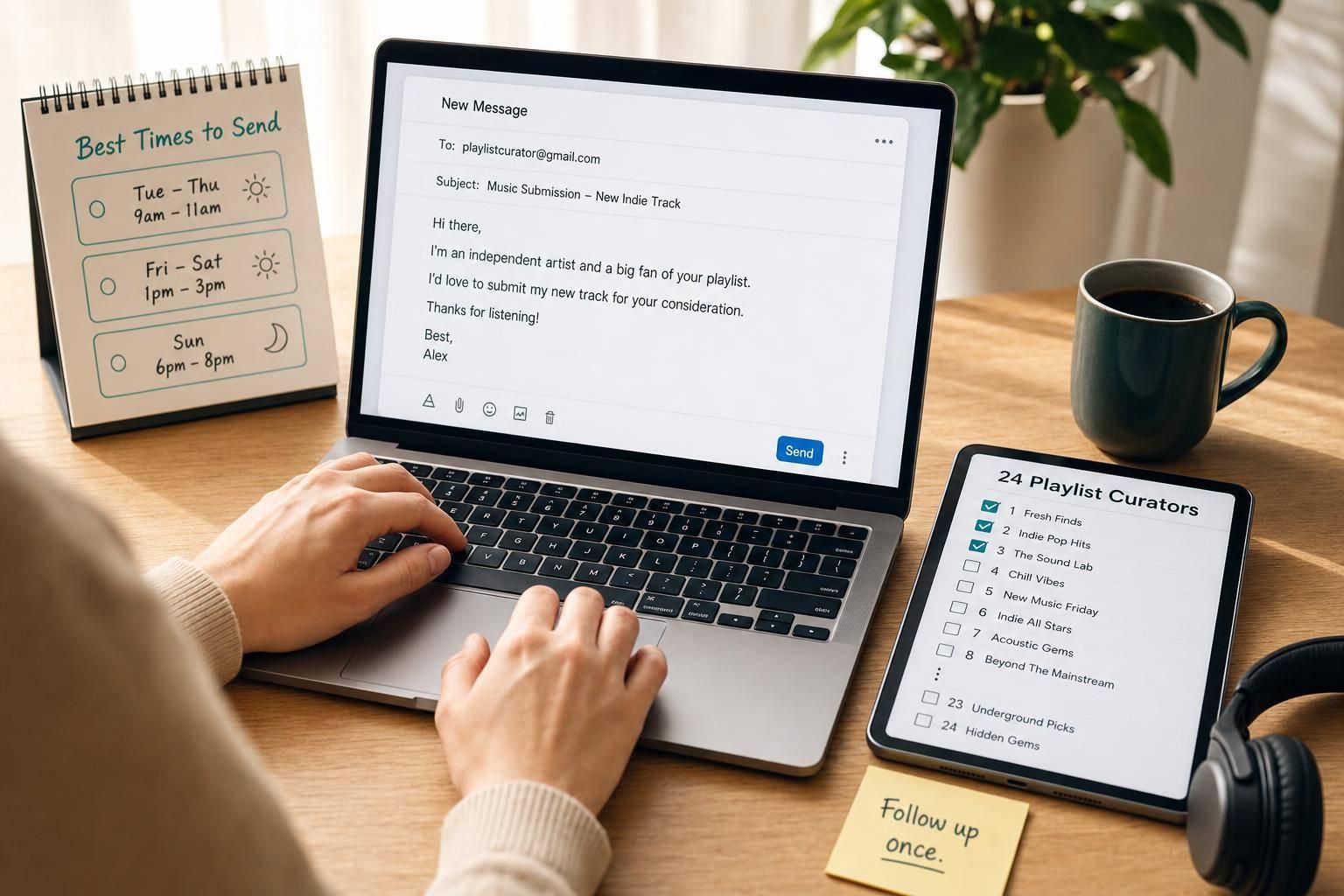
Ultimate Guide to Playlist Curator Outreach
Ultimate Guide to Playlist Curator Outreach
Playlist outreach works when I keep the list small, the pitch short, and the fit tight. With about 100,000 new songs hitting Spotify each day in 2026, I can’t win by blasting the same message to everyone.
Here’s the short version:
- I look for playlists that match my song’s genre, mood, energy, and listening setting
- I skip playlists with weak activity, odd follower-to-listener numbers, or pay-for-placement claims
- I build a short list of about 20–30 curators, then rank them by fit, reach, and indie openness
- I send a 3–4 sentence pitch under 120 words with one clear reason the song fits that playlist
- I pitch in three windows: 2–4 weeks before release, release week (often supported by a pre-save campaign), and one selective post-release follow-up
- I follow up once after 5–8 days, then stop
- I track results so each release gets easier to run
A few numbers stand out. Personalized pitches can get 22%+ response rates. Curators often update playlists every week or two, so I move on if nothing changed in the last 30 days. And if I support a playlist after getting added, a curator may be 62% more likely to feature me again.
Bottom line: this is less about volume and more about matching the right song to the right person at the right time.
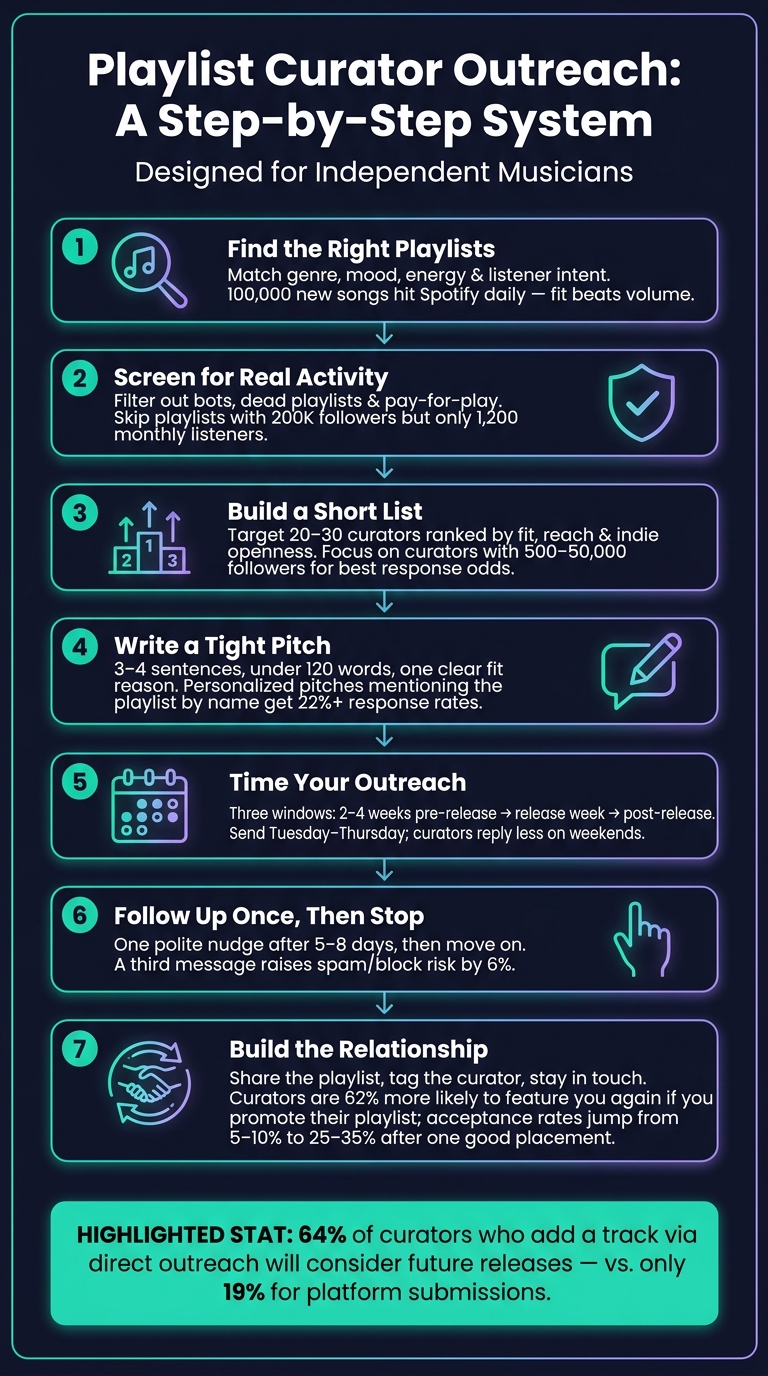
Playlist Curator Outreach: A Step-by-Step System for Independent Artists
How to Submit Your Music to Spotify Playlist Curators | Ditto Music
sbb-itb-e819543
Quick Comparison
| Part of outreach | What I do |
|---|---|
| Finding curators | Check genre, mood, recent adds, and indie-friendly patterns |
| Screening playlists | Look for recent updates, real listener signs, and clear contact info |
| Building the list | Keep it small and rank top fits first |
| Writing the pitch | Short intro, song details, fit note, and direct link |
| Timing | Pitch before release, during release week, then one selective late follow-up |
| Follow-up | One polite nudge, then stop |
| Long-term results | Track adds, streams, saves, and who is worth contacting again |
If I treat outreach like a repeatable process instead of a one-off push, each release gives me better contacts, better data, and a better shot next time.
How to Find Curators Who Actually Fit Your Release
Not every playlist is worth your time. The smart move is to focus on playlists that line up with your song's genre, mood, and listener intent. Once you're clear on how to promote your music across different platforms, you can use that lens to sort curators fast.
Match Your Song to the Playlist Style, Listener Intent, and Recent Adds
A lot of playlists are built around when and why people listen - think late-night drive, gym, focus, or dinner party - not just genre.
That matters. A song that matches the mood and energy of that setting usually has a much better shot than a song that only shares the same genre label. Searching with these use-case terms can help you find playlists that line up better with how people actually listen.
When you spot a playlist that looks promising, check the latest adds. Ask yourself: does your track sit naturally next to those songs in energy, tempo, and lyrical tone? If the answer is no, skip it.
Also take a look at the curator's pattern. If the playlist leans heavily toward major-label releases, it's less likely to be open to indie submissions.
Check Curator Activity and Real Engagement Before Reaching Out
Before you add any curator to your list, make sure the playlist is still active. Curators often refresh their playlists weekly or every other week. If nothing has been added in the last 30 days, move on.
Follower count doesn't tell you much on its own. What you want is a playlist with monthly listeners in roughly the same range as its followers. So if a playlist shows 200,000 followers but only 1,200 monthly listeners, that's a huge red flag for bot activity.
Another useful check: see whether the playlist shows up in the "Discovered On" section for the artists featured on it. If it doesn't appear there, it's probably not driving real listener activity.
It's also worth checking for a public Instagram, website, or a clear bio. And if a curator promises guaranteed placement or guaranteed streams, skip them. That's usually a bad sign.
Use these filters to sort good leads from dead ends:
| Factor | Good-fit curator | Poor-fit curator |
|---|---|---|
| Playlist relevance | Strong genre, mood, and audience match | Weak or inconsistent match |
| Update frequency | Updated regularly with recent adds | Rarely updated or abandoned |
| Engagement signals | Real listener activity; appears in "Discovered On" | Weak engagement or suspicious follower-to-listener ratios |
| Submission method | Clear contact route or stated process | No clear contact path or vague requests |
The point isn't to build a giant list. It's to build a short list of curators who are actually worth contacting. If a playlist clears these checks, add it to your outreach list.
How to Build a Small, High-Fit Outreach List
Once you've filtered curators using the checks from the previous section, don't contact everyone who makes the cut. That's where a lot of artists go off track.
Personalized pitches that mention the playlist by name can get response rates of 22% or more. On the flip side, curators who get generic bulk messages often mark senders as spam. So the goal isn't to build a giant list. It's to build a short list of people who fit.
Mass pitching looks busy. A tight list gets replies.
This step turns your research into a practical outreach list you can use. Once you know who fits, trim the pool fast.
Rank 20–30 Curators by Fit, Reach, and Openness to Indie Artists
Start with 3–5 artists who sound close to you. Then look for independent playlists that already feature them. If a curator is adding music in your lane, that's a strong signal they're worth your time.
From there, narrow the list by checking:
- How often the playlist gets updated
- Whether the curator includes newer artists along with established names
- Whether the playlist has been active in the last 2–4 weeks
Curators in the 500 to 50,000 follower range are often easier to reach. They're active, but they usually aren't buried under major-label submissions yet.
And here's the part that matters most: reach is secondary. Fit and response quality matter more.
Once you've filtered the list, sort your final names into three tiers:
| Priority Tier | Definition | Next Move |
|---|---|---|
| Strategic | Best fit; prioritize first. | Prioritize for early feedback and every release. |
| Developing | Relevant and professional; stay in touch. | Maintain periodic contact and log taste preferences. |
| Exploratory | Possible fit; test carefully. | Start narrow, observe response quality and data. |
After you've ranked your top targets, log each contact before you send anything.
Track Contacts, Deadlines, and Curator Preferences in One Place
You don't need fancy software. A simple spreadsheet works.
Use one sheet to track contacts, deadlines, and notes for every curator. Log the following details:
| Field | Example Entry |
|---|---|
| Playlist Name & URL | "Late Night Indie" [Link] |
| Curator Name/Handle | Marcus / @marcus_curates |
| Contact Method | Email (marcus@blog.com) |
| Genre/Mood Tags | Dreamy, lo-fi, 90 BPM |
| Date Pitched | Jul 6, 2026 |
| Follow-up Date | Jul 16, 2026 |
| Response Status | Sent / Follow-up Sent / Added |
| Notes on Taste | "Likes jangly guitars; RIYL Day Wave" |
| Results | 5% save rate; 200 streams |
The Notes on Taste column saves time later. When you come back to that curator for your next release, you can tailor the pitch in seconds.
The Results column shows which placements did something useful, so you know who to put first next time. Over time, that turns your outreach from guesswork into a cleaner system.
With your target list built, the next step is choosing the right time to send. This timing is especially critical when coordinating with pre-save campaigns to maximize day-one momentum.
How to Write a Short, Personalized Pitch Curators Will Actually Read
Once you have a short list of good-fit playlists, your pitch needs to show that fit fast. Curators skim. If they don’t see a match right away, they move on. That’s why your message should stay tight: 3–4 short sentences and under 120 words.
Use a Clear Pitch Structure: Intro, Track, Fit, and Link
A good pitch covers four things in this order: who you are, what the song is, why it fits the playlist, and where to hear it. Think of it like a quick decision memo, not ad copy.
Here’s the basic structure:
| Pitch Element | What to Include | What to Omit |
|---|---|---|
| Intro | Artist name and a brief "Hi [Name]" | Long career history or life story |
| Song ID | Song title, genre, mood, BPM, 2–3 RIYL artists, featured artists, and explicit/clean status | Vague descriptions like "it's a vibe" |
| Fit | The specific playlist name and a track already on it that matches your song | Generic "I love your playlist" copy |
| Link | Direct Spotify track link | MP3 attachments, zip files, or private link walls |
Use one smart link with your main streaming destinations and pre-save page to cut friction.
Personalize the Message Without Making It Long
You don’t need a long note to make it personal. One specific detail is enough. Mention a track already on the playlist, a shared tempo range, or a similar mood. Pull one detail from your research notes and use that.
For example, "fits right between Day Wave and Still Woozy tempo-wise" says a lot more than "I think my song would be a great addition." BPM, production style, and mood help the curator picture the track before pressing play.
"Personalization drives response rates." - PlaylistSupply Team
Two mistakes can sink a pitch on the spot: a typo in the curator’s name or playlist title, and a lazy opener like "Hi curator." Check both before sending. And unless you have over 50,000 monthly listeners, leave vanity metrics like stream counts out. Smaller numbers can hurt the pitch more than help it. Once the message is ready, timing and follow-up shape whether it gets seen.
When to Reach Out, How to Follow Up, and How to Keep Curator Relationships Going
Once your pitch is ready, timing plays a huge role in whether anyone even sees it. If you send it when a curator is slammed or not looking for new music, it can disappear fast. That’s why your outreach should line up with your release schedule.
Plan Outreach Around Pre-Release, Release Week, and Post-Release Data
| Outreach window | Typical timing | What to send | Why it matters |
|---|---|---|---|
| Pre-release | About 2–4 weeks before release | Private listen link, release date, short fit note | Gives curators time to review and plan |
| Release week | Release day through the first week | Live Spotify link, brief update, early traction | Makes it easy to add the track while it is fresh |
| Post-release | 2+ weeks after launch | Selective follow-up with performance signals | Supports late adds based on proven listener data |
Use these three windows in that order: pre-release first, release week second, and post-release only if the numbers back it up. Pre-release is for review. Release week is for live adds. Post-release is only for a focused follow-up when the song is showing signs that people are into it.
Once the track is live, swap in your live Spotify link and add a quick note about early traction. That can be saves, early streams, or other signs that the track is landing. If your save rate is above 4% or your skip rate is below 30% two weeks in, those are worth mentioning in one post-release follow-up.
You can use a PromoLinks.me shareable music links or pre-save pages to keep pre-release, release-week, and post-release outreach in one place.
It also helps to send pitches and follow-ups between Tuesday and Thursday. Curators tend to reply less on weekends.
Follow Up Once or Twice, Then Stop and Keep the Door Open
Send one polite follow-up after 5–8 days, then stop for that release. Keep it short. One or two sentences is enough, especially if you can point to a new stat or quickly restate why the track fits.
"A follow-up must justify its own existence. It needs to contain something the original pitch didn't: a new data point, a social proof update, or a specific reason the track fits." - Pierre-Albert Benlolo, Founder of MusicPulse
That advice matters. A third message bumps up the odds of being blocked or reported as spam by 6%. For most artists, that’s a bad trade. The goal isn’t one add at any cost. The goal is to stay on good terms so future releases have a shot too.
If a curator adds your track, act fast. Share the playlist within 48–72 hours, tag them in public, and thank them. That kind of support goes a long way. Curators are 62% more likely to feature an artist again if that artist promoted the playlist after a previous placement. And after one good placement, future pitches to that same curator can jump from about 5–10% acceptance to 25–35%.
After a placement, stop thinking only in terms of pitching and start thinking in terms of staying in touch. Reach out again only when your next release fits that curator’s lane. A short note that mentions the match, plus a nod to your last interaction, will usually work better than a cold re-introduction. That’s how a one-time pitch can turn into a working relationship.
Conclusion: How the Outreach Process Gets Better With Every Release
Playlist curator outreach works best when you treat it like a repeatable system. Set it up once, then use each release to learn what worked, what fell flat, and where to focus next time.
Every campaign gives you better data and warmer contacts. You start to see which curators are a strong fit, which lists need trimming, and which people are worth coming back to. Over time, that makes the whole process sharper and less hit-or-miss.
The curators who have added your music before should be at the top of your list. They already know your sound, which makes them your best repeat targets. Each release also shows you which saves and follows were legit, which replies turned into something useful, and which contacts deserve your attention in the next round.
That’s why it makes more sense to measure placements than to just count them. 64% of curators who add a track through direct outreach will consider future releases from that artist, compared to only 19% for platform-based submissions. Past placements give you the strongest starting point for the next campaign.
Mass pitching doesn’t create momentum. Relationships do. Each release gives you another shot to sharpen fit, improve timing, and keep in touch with the curators most likely to reply next time.
FAQs
How do I know if a playlist is actually worth pitching?
Focus on fit and engagement, not follower count alone.
The playlist should line up with your track’s genre, mood, tempo, and production style. It also helps if the playlist is updated on a regular basis. That’s usually a good sign the curator is active and paying attention.
You also want to see real listener activity. A playlist with a huge follower count but barely any track plays can be a red flag. Put more weight on playlists that already support artists in your lane. And steer clear of playlists that lead to sudden, unexplained stream spikes.
What should I do if no curators reply to my pitch?
Don’t take it personally. Curators often get hundreds of messages each week, so it’s easy for a pitch to get buried.
Wait 7 to 14 days, then send one polite, brief follow-up that mentions your original pitch.
If you still don’t hear back, move on. Sending repeated messages can get flagged as spam and may hurt your reputation. Put that energy into building momentum on social media and getting ready for your next release.
How can I reuse my outreach list for future releases?
Treat your outreach list like a long-term asset. Don’t just send pitches and move on. Log every interaction in a spreadsheet, including curator names, contact methods, responses, and outcomes.
That way, each release gives you a clearer picture of who opens emails, who replies, and who actually adds your music. After every release, look back at the people who responded well and turn them into your go-to shortlist for the next one.
When you have a new track out, reach back out to curators who added your music before. They already know your sound, so the conversation is warmer from the start. You can use PromoLinks.me to share smart links or pre-save campaigns, but the key part is simple: keep every pitch personal.
Related Blog Posts
Ready to create your smart links?
Join thousands of artists using PromoLinks to promote their music smarter.
Get Started Free