Track Sequencing for Listener Retention
Track order can change how long people listen. If your first songs hit fast, you can cut skips, keep more listeners through the full release, and improve signals like saves and tracks played per session. These signals are often primed by a pre-save campaign that drives early engagement.
Here’s the short version:
- The first 2 songs matter most
- Intros over 20 seconds can lead to 45% more skips
- A skip rate under 15% is a strong target
- A save rate of 3% to 8% is a solid sign
- Singles, EPs, and albums need different track order plans
- Testing 2 to 3 sequence drafts before release can show where listeners drop off
Put another way: if people leave early, I’d check the sequence before I blamed the songs.
A simple plan works best:
- Start with a track that hooks fast
- Put another strong song early
- Change energy and mood so the middle doesn’t drag
- End with a track that feels like a proper finish
- Test different orders and compare skips, saves, completion, and session length
If I’m sequencing a single, I focus on the first few seconds. If I’m sequencing an EP, I try to keep momentum across 3 to 6 tracks. If I’m sequencing an album, I front-load the songs with the best retention and use the middle for more range.
Song Order Secrets: How to Sequence your Album or EP!
sbb-itb-e819543
Quick Comparison
| Release Type | Main Goal | Best Track Placement |
|---|---|---|
| Single | Stop early skips | Hook in the first 5 to 20 seconds |
| EP | Keep people moving through the full set | Strong opener, strong track 2, shift in the middle, replayable closer |
| Album | Hold attention across a longer session | Put top-retention songs in tracks 1–3 |
The core idea is simple: good sequencing keeps the listener from asking, “Should I skip this?” This is a vital part of your music marketing checklist to ensure every release lands with impact.
Sequencing Rules That Reduce Skips
Build a Clear Listening Arc from Opener to Closer
Use music analytics like skip-rate and session-length signals above to shape how the release starts, carries through, and ends. Set the track order so each song pulls the listener into the next one. Start with speed, put a momentum track early, and finish with a clear payoff. That kind of arc can cut early skips, keep sessions going longer, and drive more full-release plays.
The opener does not have to be the most commercial song. But it does need to hook fast and show the listener what kind of release this is. Its job is simple: keep things moving. A strong song in the early middle helps hold attention once the opener has done its work. The closer should land the release in a clean, satisfying way. When each slot has a clear purpose, people are less likely to bail before the end.
Once the main arc is in place, change the intensity across the sequence so the middle does not sag.
Use Energy, Tempo, and Mood Shifts to Prevent Drop-Off
Don’t stack songs that hit with the same intensity back to back. Change the energy, tempo, and mood as the release moves along. That shift keeps the sequence alive and helps you avoid a flat middle. It also cuts listener fatigue.
Track order works best when each song gives the listener a reason to stay almost right away.
Keep the Hook Early in Each Track
Sequencing also depends on how fast each track delivers. Put the hook or first vocal before the 20-second mark. Be most strict about this with the opener and the first few tracks.
How to Sequence Singles, EPs, and Albums Differently
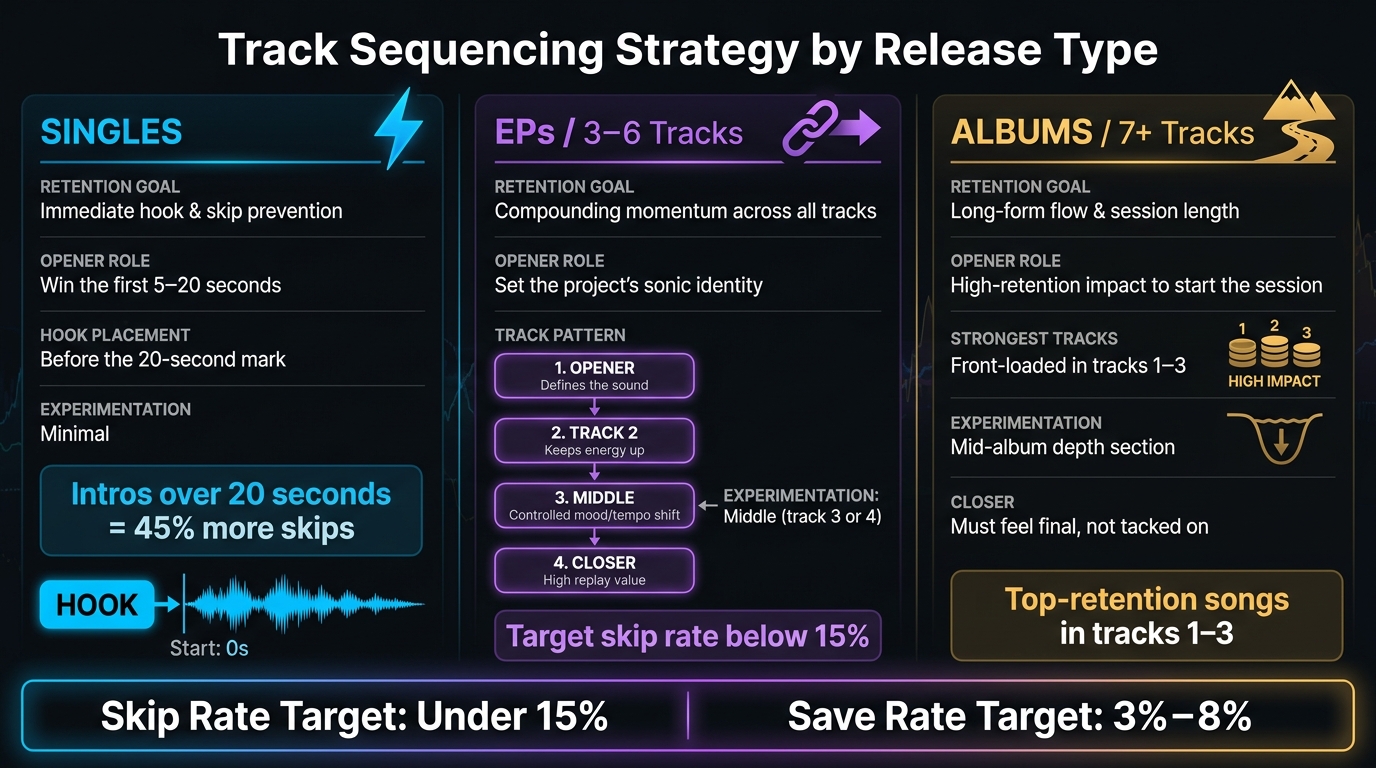
Track Sequencing Strategy by Release Type: Singles, EPs & Albums
Singles, EPs, and albums call for different sequencing. Short releases need speed. Longer releases need flow.
Singles: Win the First Seconds and Support Waterfall Release Plans
With singles, the opening hook does a lot of the heavy lifting. Those first seconds often decide if someone saves the track or skips it.
Singles also matter across a release campaign, not just inside one song. If you put out lead singles before a full project, each track sets up what comes next. A staggered waterfall release plan drops songs one by one before the full EP or album lands, often supported by pre-save campaigns to build momentum. That same speed-first mindset still matters for EPs and albums. The difference is that the sequencing job gets bigger.
EPs: Keep Momentum Across 3 to 6 Tracks
An EP has less room for drift. Every track needs to pull the listener into the next one.
The main goal is to keep completion rate high and increase tracks played per session. A simple four-stage pattern helps:
- Start with an opener that defines the release’s sound
- Follow with a second track that keeps the energy up
- Use the middle for a controlled shift in mood or tempo
- End with a closer that has replay value
A waterfall EP can also keep the release active in Release Radar as each track rolls out.
Albums: Balance Front-Loaded Impact with Long-Form Flow
Once the track count goes up, the goal changes. It’s not just about momentum anymore. It’s about endurance.
Front-loading the strongest songs can help session length and full-release plays. In plain English: tracks 1–3 should carry the songs with the highest retention. The middle of the album is usually the best spot to take a few chances. Then, later in the tracklist, add songs that reward people who stayed for the full run. And the closer? It should feel final, not tacked on.
| Singles | EPs (3–6 Tracks) | Albums (7+ Tracks) | |
|---|---|---|---|
| Retention Goal | Immediate hook & skip prevention | Compounding momentum | Long-form flow & session length |
| Opener Role | Win the first 5–20 seconds | Set the project's sonic identity | High-retention impact to start the session |
| Experimentation Placement | Minimal | Middle (track 3 or 4) | Mid-album depth section |
| Strongest Track Placement | N/A (the song itself) | Track 1 | Tracks 1–3 (front-loaded) |
How to Test Track Order Before Release
Test two or three track orders before release. It’s a simple step, but it can show where listeners lose interest in ways you’d never spot by listening alone.
Run Private Listening Tests with 2 to 3 Sequence Drafts
Export two or three track-order drafts and play each one straight through. While you listen, mark the exact moment you feel like skipping. Write down the track and timestamp. Then score each draft based on where listeners stall, skip, or make it to the end.
Next, share each version with a small group of trusted listeners who match your target audience. Pay close attention to sharp jumps in energy or tempo between songs. During this stage, keep unreleased music protected with a passworded smart link or email capture.
Measure Retention Signals During Pre-Release Testing
Use the same retention benchmarks for every draft so the comparison stays clean. Focus on signals like:
- Skips at the 5–10 second mark: often means the intro takes too long
- Skips at 30 seconds: often means the track hasn’t hooked the listener
- Drop-off at the midpoint: often points to an energy dip
Don’t stop at skips. Track each song’s completion rate, how many songs people played in one sitting, and whether they saved or favorited anything.
A skip rate below 15% and a save rate between 3% and 8% are the numbers to beat. Compare Sequence A and Sequence B using those same data points. If one version keeps people listening for more tracks per session, that’s probably the one to use.
Use PromoLinks.me to Track Listening Paths and Campaign Engagement
Once you move from private testing into pre-release planning, use PromoLinks.me to tie sequencing choices to listener behavior. Create one smart link for each draft and share each link with a different test group. That keeps the data separate. PromoLinks.me’s real-time analytics let you compare engagement across drafts. You can also add UTM parameters, like ?utm_source=sequence_a, to keep each draft’s data separated in your analytics dashboard.
Pre-save campaigns, launched 2–4 weeks before release, give you one more signal to work with. About 70% of users who pre-save a release will stream it in the first week, so that audience can tell you a lot about early listener intent. Use fan email capture to ask for short feedback on which sequence held attention best.
Go with the draft that shows the lower early-skip rate, the higher completion rate, and the stronger save rate. Use that sequence to lock in the release plan.
Conclusion: Match Your Track Order to Your Release Strategy
Track sequencing has a direct effect on skip rate, session length, and full-release plays. A skip rate below 15% and a save rate of 3% to 8% are solid signs that the order is doing its job. If retention looks weak, check the sequence first.
After that, the best order depends on the type of release. Retention shifts based on length, so the arc needs to change with the format. Singles need to hook people right away. Intros longer than 20 seconds push skip rates up by 45%. EPs need steady momentum across 3 to 6 tracks. Albums need a strong opening run and a clean ending. Put simply: one sequence won’t fit singles, EPs, and albums alike.
Testing before launch cuts down on guesswork. Pick the draft that lines up best with your release goal. You can also explore more music promotion guides to refine your strategy.
Once the release is out, use the same metrics to shape the next sequence. Check skip rate, completion rate, and tracks played per session, then look for the spots where listeners drop off. If a track in the middle of your EP shows a sharp dip, that’s a sequencing clue for the next project. Better releases come from better sequencing choices, not just better songs.
FAQs
How do I know if my track order is hurting retention?
Check your artist dashboard for skip rate, save-to-stream ratio, and streams per listener. Those numbers can tell you a lot, fast.
A skip rate above 15% often points to listener drop-off. In many cases, that comes back to intros that run longer than 20 seconds or an opening that doesn’t hook people right away.
If your save rate is high but your skip rate is also climbing, that’s a clue: people may like the song, but the start isn’t pulling them in soon enough.
And if your streams-per-listener ratio falls below 1.5, listeners may be giving the project one play and then moving on. That can be a sign that your track order needs another look.
Should my best song go first?
Not always. You want to hook listeners right away, but your strongest track isn't automatically the right opener.
The main goal is to keep skip rates down with a short intro. Tracks with intros longer than 20 seconds often get skipped more often. Start with a strong moment, and keep the flow engaging so more people stick with the track and save it.
What’s the easiest way to test sequence drafts before release?
Use PromoLinks.me to build smart links and pre-save campaigns, then share them with a controlled audience. That gives you a clean way to track click-through rates and referral sources, so you can see which track orders or promo hooks land best.
You can check the analytics dashboard in real time and measure results against your baseline before launch. Even small, data-backed tweaks can help improve listener retention and algorithmic performance.
Related Blog Posts
Ready to create your smart links?
Join thousands of artists using PromoLinks to promote their music smarter.
Get Started Free